
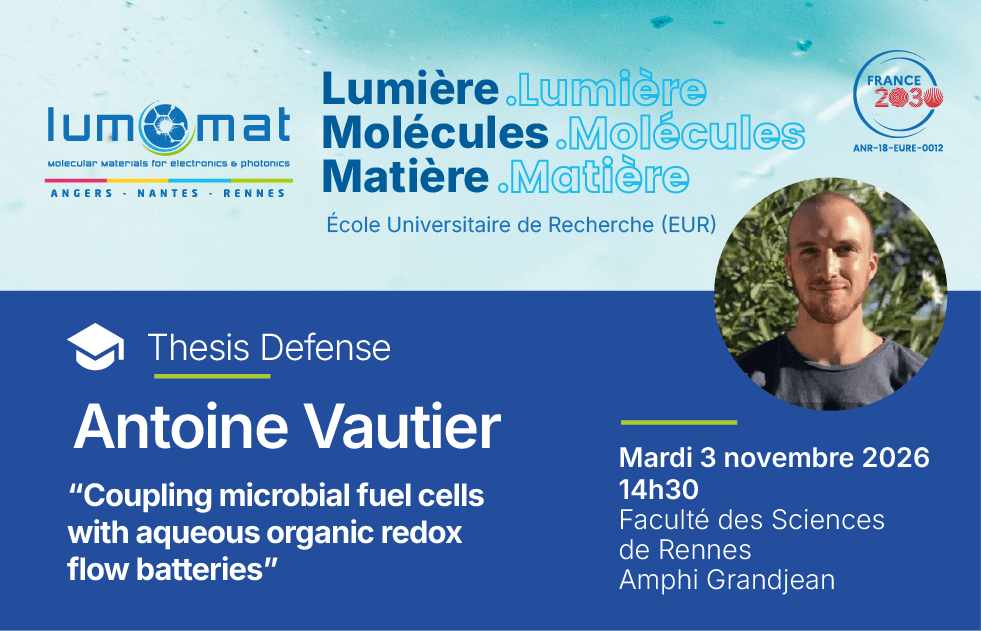
🎓 [THESIS DEFENSE] – Antoine Vautier will defend his PhD thesis: 🔬 “Coupling microbial fuel cells with aqueous organic redox flow batteries” 📅 Tuesday 3 November 2026 at 14:30 – ISCR/Université de Rennes – Amphi Grandjean This thesis is labelled by EUR LUMOMAT
This thesis is supervised by Prof. Frédéric BARRIERE – ISCR – Université de Rennes, Dr. Florence GENESTE – CNRS/ISCR – Université de Rennes and Dr. James BEHAN – CNRS/ISCR – Université de Rennes
Examining Committee :
➖ Dr. Christelle GAUTIER – CNRS/MOLTECH-Anjou – Université d’Angers – Examiner
➖ Dr. Mathieu ETIENNE – CNRS/LCPME – Université de Lorraine – Reviewer
➖ Dr. Estelle LEBEGUE – CEISAM – Nantes Université – Reviewer
➖ Dr. Charlotte BODIN – ISCR – Université de Rennes – Invited Member
[📄 ABSTRACT] Microbial fuel cells (MFCs) convert the energy contained in organic matter into electricity, while offering potential for effluent treatment. However, their low power density limits their direct use as an energy source. Coupling MFCs with redox flow batteries (RFBs) is a strategy that allows the biological production of electricity to be separated from its storage. This thesis explores the challenges associated with this coupling and various strategies for overcoming them. The development of new electron acceptors at the MFC cathode has expanded the library of molecules that could potentially be used as negolytes in RFBs.
A sulphonated phenazine (PABS) has, in particular, shown promise for direct MFC/RFB coupling, owing to its redox potential and solubility in aqueous media. An indirect coupling approach based on the biosynthesis of redox mediators, notably phenazine-1-carboxylic acid (PCA), has been investigated. This research highlights the challenges associated with the compatibility of the electrochemical and physicochemical properties of the mediators, as well as the differences in power and scale between MFCs and RFBs. It thus opens up prospects for the development of hybrid systems combining energy production, storage and effluent treatment properties.

 ENG
 FR