Journée Scientifique Lumomat 8 Octobre 2026 à Rennes – 5e édition
5e édition de la Journée Scientifique Lumomat
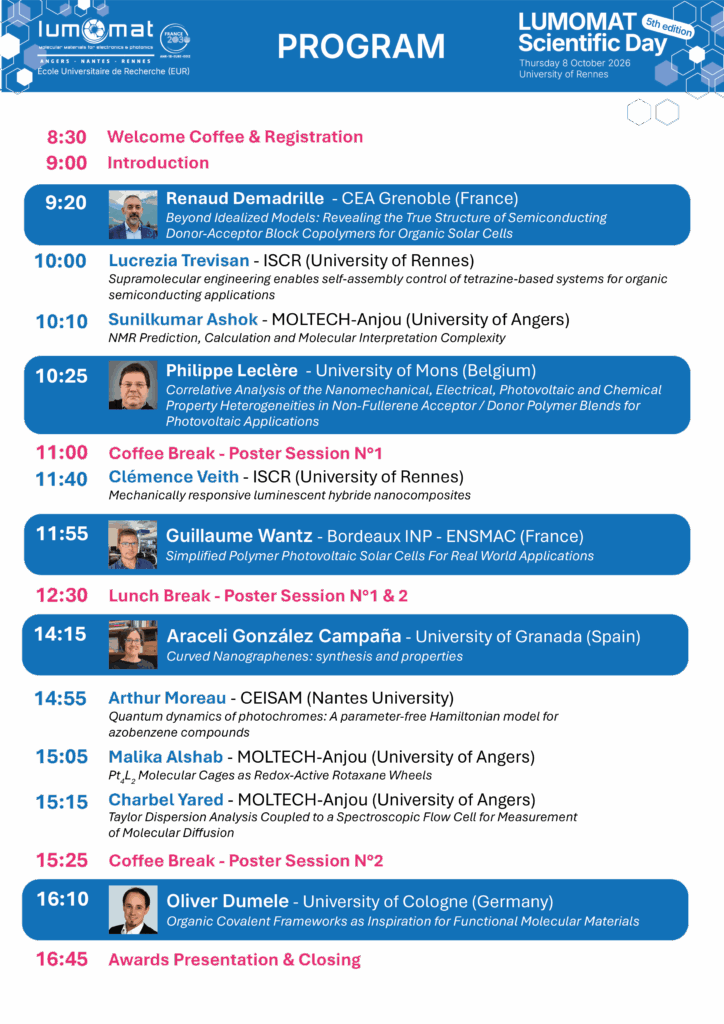
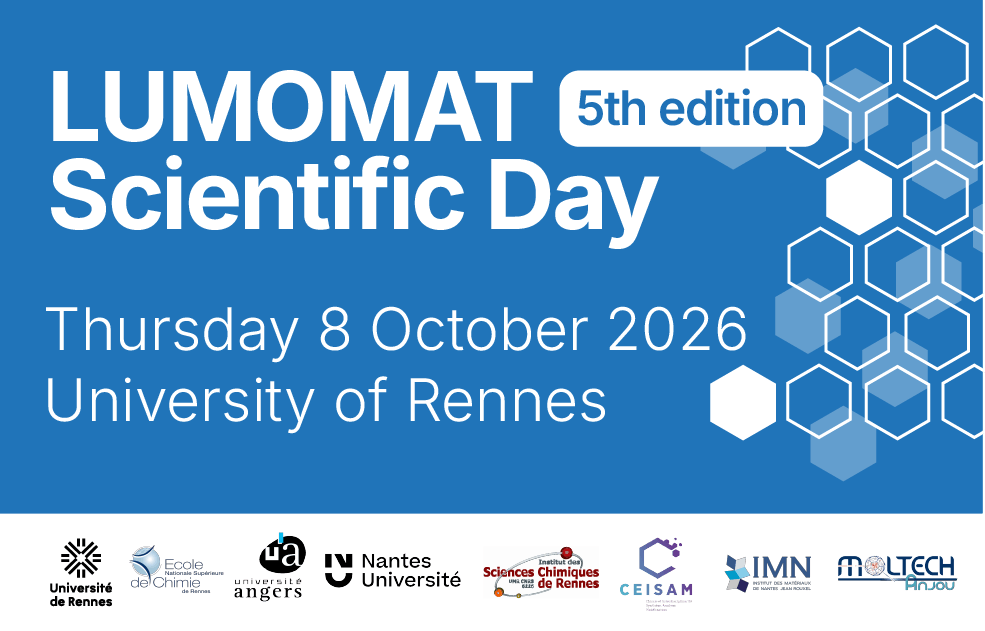
L’École Universitaire de Recherche Lumomat organise sa 5ème Journée Scientifique qui se déroulera le Jeudi 8 Octobre 2026 à Rennes.
📆 Programme de la journée
- 4 conférences plénières animées par des chercheurs et chercheuses.
- Des communications orales des doctorantes et doctorants du réseau Lumomat (sur sélection).
- Une session posters (sur simple inscription).
Speakers
Renaud Demadrille - CEA Grenoble - France
Beyond Idealized Models: Revealing the True Structure of Semiconducting Donor-Acceptor Block Copolymers for Organic Solar Cells
Antoine Curé, Pierre-Alain Bayle, Lucie Rivet, Yann Kervella, Cyril Aumaître and Renaud Demadrille. CEA Grenoble, 17 Avenue des Martyrs, 38000, Grenoble, France
Single-component (SC) polymers represent an emerging class of materials for organic photovoltaics, offering the potential of combining high power conversion efficiencies with significantly enhanced operational stability compared to conventional heterojunction systems based on non-fullerene acceptors (NFAs).[1–2] Despite their promise, the detailed structural characterization of SC polymers remains limited, and current descriptions are often insufficient to establish robust structure-property relationships. Such understanding is essential for rational material design and for advancing the development of next-generation organic photovoltaic systems.
Here, we propose a rigorous and comprehensive strategy for elucidating the structure of SC polymers, enabling a deeper understanding of their molecular architecture and associated structure–property relationships. We recently established a detailed characterization protocol using a model SC polymer based on the donor polymer PTQ10 and an NFA-based polymer, PIDTe.[3] By employing a model small-molecule approach, we identified characteristic proton NMR signals associated with heterojunctions and confirmed their presence in the polymeric materials using a range of advanced two-dimensional NMR techniques. For the first time, we were able to quantify the average number of heterojunctions (NoH) in this class of copolymers.
Furthermore, by synthesizing additional PTQ10-based SC polymers, we demonstrated the general applicability of our methodology to related systems, with clear potential for extension to other SC polymer architectures.[4] Overall, this work establishes a reliable and broadly applicable strategy for the accurate structural characterization of SC polymers intended for use in organic electronics and organic photovoltaic applications.
References: [1] Y. Zheng, Y. Wu, Z. Chen, X. Xia, Y. Li, Q. Wu, Y. Lin, X. Lu, X. Hao, J. Min, J. Mater. Chem. A 2023, 11, 8961.[2] Y. Cheng, Q. Mao, C. Zhou, X. Huang, J. Liu, J. Deng, Z. Sun, S. Jeong, Y. Cho, Y. Zhang, B. Huang, F. Wu, C. Yang, L. Chen, Angew Chem Int Ed 2023, e202308267.[3] L. Rivet, A. Curé, C. Jutard, S. Fauvel, R. Demadrille, A. J. Riquelme, C. Aumaître, J. Mater. Chem. C, 2025, 13, 21357.[4] A. Curé, P-A. Bayle, L. Rivet, Y. Kervella, R. Demadrille, C. Aumaître, Adv. Science 2026, 13:e2226.
Funding: The authors are grateful to Agence National de la Recherche (ANR) for the grant ANR-22-CE06-0018, acronym: MONOPOLY. R.D. gratefully acknowledges the financial support received from the Fulbright Visiting Scholar Program, which is sponsored by the U.S. Department of State, the French-American Fulbright Commission, and Université Grenoble Alpes.
Philippe Leclère - University of Mons - Belgium
Correlative Analysis of the Nanomechanical, Electrical, Photovoltaic and Chemical Property Heterogeneities in Non-Fullerene Acceptor / Donor Polymer Blends for Photovoltaic Applications
Organic photovoltaic systems based on non-fullerene acceptors (NFAs) have complex nanoscopic morphologies. These systems can form nano-sized domains as well as mixed phases. In this context, the use of a single experimental technique can lead to ambiguous interpretations of the local morphology. In this work, we implement a correlative approach combining several scanning probe microscopy and spectroscopy techniques performed on the same area of the photovoltaic polymer blend sample : infrared nano-spectroscopy (AFM-IR), nanomechanical mapping in Peak Force Tapping mode and Kelvin microscopy (KPFM). Each technique provides additional chemical, mechanical or electronic information but can also lead to partial interpretations when used alone. A correlative approach thus makes it possible to cross-reference these different pieces of information to obtain a more reliable description of the local morphology. To validate the chemical analysis approach by AFM-IR, a first PBDB-T:Y6 (1:1) reference system prepared from a chlorobenzene/chloroform mixture is studied. Chemical distribution maps of the two components are obtained from operations on chemical maps recorded at different wavenumbers characteristic of the studied materials. This methodology is then applied to a PBDB-T:Y6 mixture (1:0.75) prepared from chloroform, allowing to localize donor-acceptor interfaces and correlate chemical, mechanical and electronic contrasts at the nanoscale. These results show that a correlative approach in local probe microscopy, performed on the same sample area, allows us to obtain a more robust interpretation of the morphology of NFA mixtures than the use of a single technique. This will aim to better understand the structural and electronic organization of the materials used in organic photovoltaic cells as well as their degradation mechanism.
Guillaume Wantz - Bordeaux INP ENSMAC - France
Simplified Polymer Photovoltaic Solar Cells For Real World Applications
Printable organic photovoltaic solar cells (OPV), i.e. polymer solar cells, have now reached impressive power conversion efficiencies at lab scale over 20%. It is one crucial milestone towards the deployment of OPV products in real life. OPV holds many promisses including potential low cost, large scale, low temperature processing, low energy payback time, low carbon footprint for the production of photovoltaic modules exempt of critical raw materials. However, today, not all are yet scientifically achieved. For example, commercially available OPV modules suffer from low PCE, from 3 to 5 % (30-50 Wp/m2) and are made with still costly raw materials mostly processed from toxic organic solvents. It is a matter of time for the industrial players to catch up with recent academic research to push industrial OPV performances further. This presentation will focuss on our recent attempts to simplify the OPV device structure in particular by removing interlayers processing steps thanks to the use of doping strategies or self-assembled monolayers. The presentation will end showing unpublished results obtained while monitoring OPV-powered fabrics in various outdoor real world conditions.
Araceli González Campaña - University of Grenada - Spain
Curved Nanographenes: synthesis and properties
The bottom-up synthesis of well-defined polycyclic conjugated hydrocarbons (PCHs) is still a scientific challenge, being key for the development of material science. The enormous research effort dedicated to carbon-based materials has leaded to a huge bloom of novel architectures such as nanobelts or hoops, chiral nanostructures, bowl- and saddle-shapes, doped or open-shell analogues. Their unique curved structures open novel avenues for applications due to the optical and electronical properties that might arise.1a Within this context, we have been focused on the synthesis and evaluation of properties of saddle-helical hybrid nanographenes.1b
Herein, our recent advances in the synthesis of distorted graphene related molecules will be discussed. Both, the in-solution2 and on-surface3 strategies will be presented. The saddle curvature can be also introduced in nanohoops offering interesting supramolecular behaviour.4 In this sense, polystyrene microbeads loaded with curved nanographenes generate functional light emitting microcomposite acting as optical microresonators.5
Figure 1. Heptagon-containing nanographenes embedded into a superhelicene (left)2, a cycloparaphenylene (center)3 or loaded on polystyrene microbeads (right)4.
References
- a) W.-S. Wong, and M. Stepien, Trends in Chemistry. 2022, 4, 573; (b); I. R. Márquez, et al. Chem. Sci. 2017, 8, 1068.
- S. Míguez-Lago, I. F. A. Mariz, M. A. Medel, J. M. Cuerva, E. Maçôas, C. M. Cruz, and A. G. Campaña, Chem. Sci., 2022, 13, 10267.
- F. Villalobos, J. Berger, A. Matěj, R. Nieman, A. Sánchez-Grande, D. Soler, A. Pinar Solé, H. Lischka, M. Matoušek, J. Brabec, L. Veis, A. Millan, C. Sánchez-Sánchez, A. G. Campaña, J. M. Cuerva, P. Jelínek, Chem, 2024, DOI: 10.1016/j.chempr.2024.09.015
- J. P. Mora-Fuentes, M. D. Codesal, M. Reale, C. M. Cruz, V. G. Jiménez, A. Sciortino, M. Cannas, F. Messina, V. Blanco, and A. G. Campaña, Angew. Chem. Int. Ed. 2023, e202301356.
- M. Reale, E. Marino, E. Maçôas, F. Ciccarello, M. Cannas, C. M. Cruz, A. G. Campaña, A. Sciortino, F. Messina, Adv. Funct. Mater., 2024, 34, 2402079.
Oliver Dumele - University of Cologne - Germany
Organic Covalent Frameworks as Inspiration for Functional Molecular Materials
Institute of Organic Chemistry, University of Cologne, Greinstrasse 4, 50939 Cologne, Germany
Constructing Organic Covalent Frameworks (COFs) from advanced molecular building blocks can achieve novel functional materials.[1,2] Inspired by the porous structure of COFs, we developed a research line towards tubular frameworks based on cyclic monomers.[3] Exploring these highly strained macrocycles in the context of supramolecular chemistry has led to a new host family with confined inner space for the complexation of cationic crown ethers.[4-5] Further macrocycles followed these developments having pure hydrocarbon scaffolds, such as cycloazulenylene.[6]
Finally, a photochemical spin state switch has derived from attempts of synthesizing chiral COFs based on helicenes.[7] The helicene-based photoswitch shows bistable spin states upon irradiation with light at cryogenic temperatures, which forms a paramagnetic diradical state. The process is fully reversible under thermal conditions and heating to room temperature recovers the diamagnetic closed-shell form. These research fields establish a convergent strategy towards functional bulk and molecular materials.
References
1) J. Sprachmann, T. Wachsmuth, M. Bhosale, D. Burmeister, G. J. Smales, M. Schmidt, Z. Kochovski, N. Grabicki, R. Wessling, E. List-Kratochvil, B. Esser, O. Dumele, J. Am. Chem. Soc. 2023, 145, 2840–2851.
2) S. Pallasch, M. Bhosale, G. J. Smales, C. Schmidt, S. Riedel, Z. Zhao-Karger, B. Esser, O. Dumele, ChemRxiv 2023, 64ca9b41dfabaf06ff982e2b.
3) N. Grabicki, O. Dumele, Synlett 2022, 33, 1719853.
4) N. Grabicki, K. T. D. Nguyen, S. Weidner, O. Dumele, Angew. Chem. Int. Ed. 2021, 60, 14909–14914.
5) N. Grabicki, S. Fisher, O. Dumele, Angew. Chem. Int. Ed. 2023, 62, e202217917.
6) C. Douglas, J. Sprachmann, D. Dunlop, J. Schlecht, J. Neudörfl, T. Wachsmuth, J. Frost, T. Slanina, O. Dumele, Angew. Chem. Int. Ed. 2026, e2204400.
7) K. Günther, N. Grabicki, B. Battistella, L. Grubert, O. Dumele, J. Am. Chem. Soc. 2022, 144, 8707–8716.
Doctorants et doctorantes : valorisez vos travaux !
Inscrivez-vous dès maintenant pour participer à la session posters.
Si vous candidatez également pour une communication orale, merci de déposer votre abstract directement via le formulaire d’inscription. La date limite de soumission des résumés est fixée au lundi 7 Septembre 2026.
Modalités d'inscription
L’inscription est obligatoire pour toutes et tous. Pour les doctorants et doctorantes désirant présenter un poster, vous devez simplement l’indiquer lors de votre inscription. Le dépôt d’un abstract est quant à lui réservé exclusivement aux candidats souhaitant effectuer une communication orale.
Inscriptions : jusqu’au Lundi 14 Septembre 2026
Deadline pour le dépôt des abstracts : jusqu’au Lundi 7 Septembre 2026
Journée Scientifique Lumomat 8 Octobre 2026 à Rennes – 5e édition Lire la suite »