News

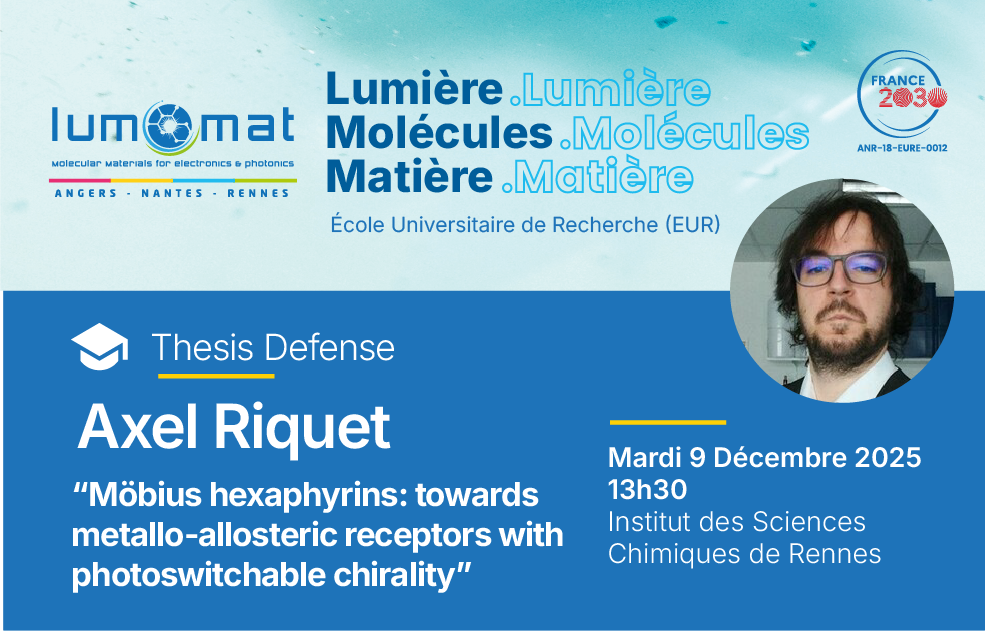
Thesis Defense – Axel Riquet – Tuesday December 9th 2025: Möbius hexaphyrins: towards metallo-allosteric receptors with photoswitchable chirality

🎓 Thesis defense – Axel Riquet will defend her PhD thesis: möbius hexaphyrins: towards metallo-allosteric receptors with photoswitchable chirality
📅 Tuesday December 9th 2025 at 13:30 at the Rennes Institute of Chemical Sciences – Beaulieu Campus – Salle 160


This thesis is supervised by Dr. Stéphane Le Gac – ISRC / Université de Rennes
Examining Committee :
➖ Dr. Céline Olivier – Institut des Sciences Moléculaires de Bordeaux – Reviewer
➖ Prof. Alexandre Martinez – Institut des Sciences Moléculaires de Marseille – Reviewer
➖ Dr. Laure Guy – École Normale Supérieure de Lyon – Examiner

This thesis is supported by University of Rennes

📄 [Abstract] Hexaphyrins are dynamic pyrrolic macrocycles which are able to adopt a Möbius ring conformation. This peculiar scaffold possesses an inherent topological helical chirality. This thesis focuses on the chirality induction and its modulation. To achieve this, several innovative strategies have been employed. Firstly, with the use of hexaphyrine bearing a chiral amine or carboxylic acid arm. The formation of zinc(II) complexes with exogeneous azo ligands allowed the obtention of impressive chirality inductions with d.e. up to >95%. The chiroptical activity of these systems has been modulated thanks to the trans->cis photoisomerization of the azo ligand giving rise to the formation of the very first Möbius ring with photoswitchable chiroptical activity. Also, new hexaphyrins with a second chiral recognition site composed of a squaramid unit, overhanging the ring, have been developped. Chirality inductions by remote control have been obtained thanks to different processes such as recognition or protonation. The modulation of the arrangement of the two recognition sites by conformational changes induced by complexation has also been observed. The promising results of these two strategies lay the foundation for the formation of allosteric receptors with photoswitchable chirality.


🎓 Soutenance de Thèse – Axel Riquel soutiendra sa thèse intitulée : hexaphyrines de Möbius : vers des récepteurs métallo-allostériques à chiralité photo-commutable
📅 Mardi 9 Décembre 2025 à 13h30 à l’Institut des Sciences Chimiques de Rennes – Campus de Beaulieu – Salle 160

Cette thèse est dirigée par Dr. Stéphane Le Gac – ISRC / Université de Rennes
Jury :
➖ Dr. Céline Olivier – Institut des Sciences Moléculaires de Bordeaux – Rapporteur
➖ Prof. Alexandre Martinez – Institut des Sciences Moléculaires de Marseille – Rapporteur
➖ Dr. Laure Guy – École Normale Supérieure de Lyon – Examinatrice

Cette thèse est soutenue par l’Université de Rennes

Thesis Defense – Axel Riquet – Tuesday December 9th 2025: Möbius hexaphyrins: towards metallo-allosteric receptors with photoswitchable chirality Read More »

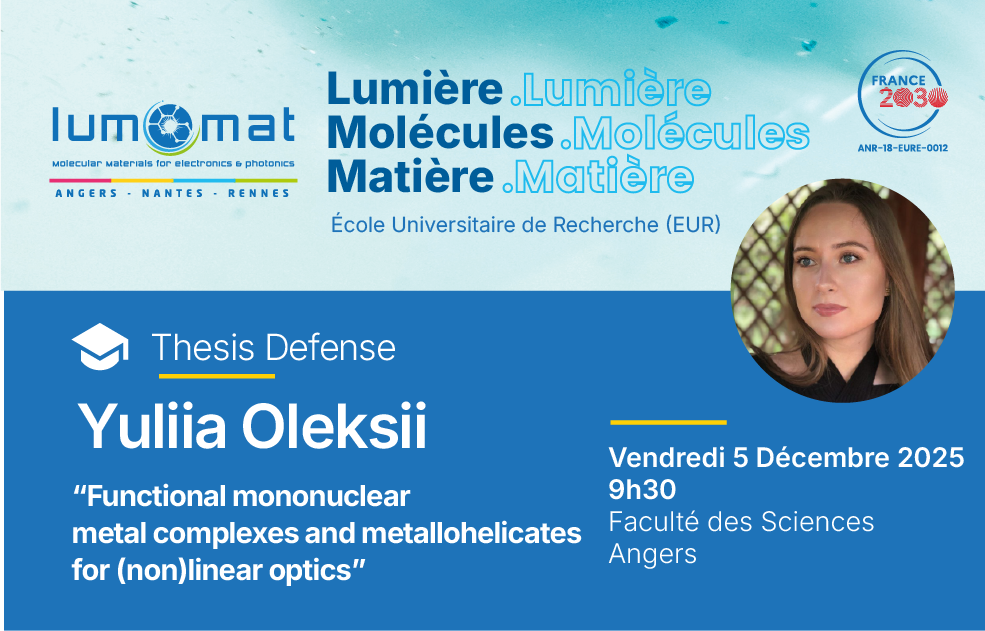
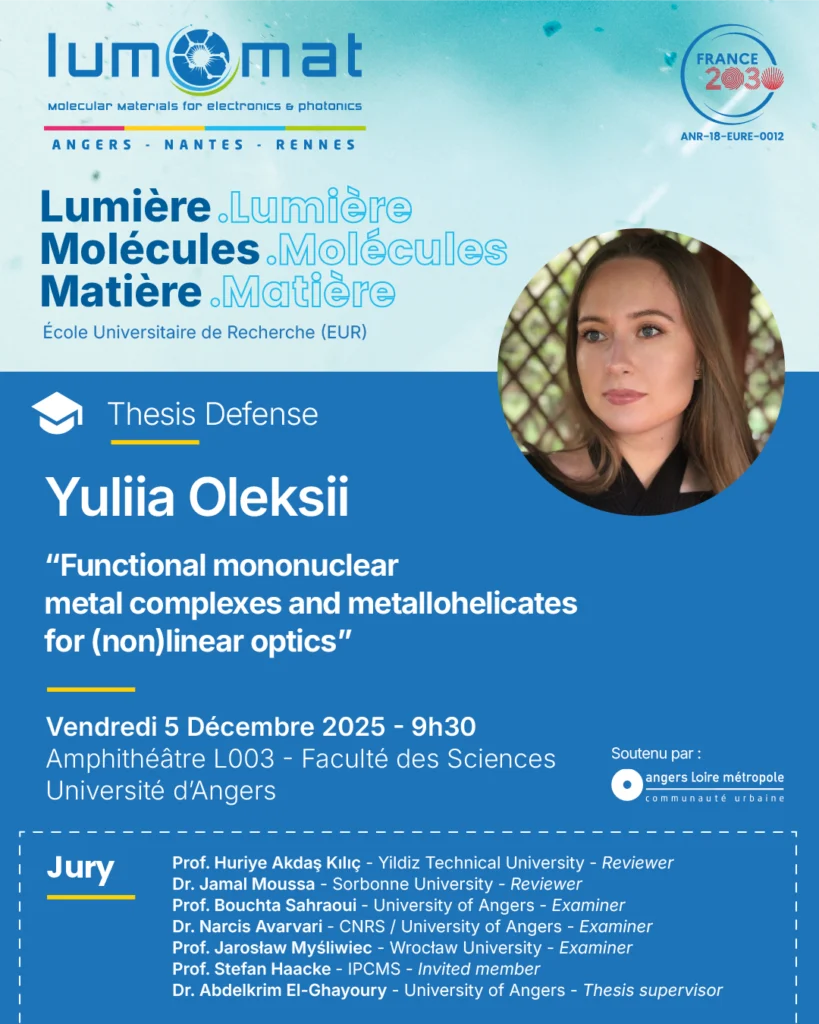
Thesis Defense – Yuliia Oleksii – Friday December 5th 2025: Functional mononuclear metal complexes and metallohelicates for (non)linear optics

🎓 Thesis Defense – Yuliia Oleksii will defend her PhD thesis: functional mononuclear metal complexes and metallohelicates for (non)linear optics
📅 Friday December 5th 2025 at 9:30 at University of Angers – Faculty of Science – Amphitheatre L003


This thesis is supervised by Dr. Abdelkrim El-Ghayoury – University of Angers

Examining Committee :
➖ Prof. Huriye Akdağ Kılıç – Yildiz Technical University – Reviewer
➖ Dr. Jamal Moussa – Sorbonne University – Reviewer
➖ Prof. Bouchta Sahraoui – University of Angers – Examiner
➖ Dr. Narcis Avarvari – CNRS/University of Angers – Examiner
➖ Prof. Jarosław Myśliwiec – Wrocław University – Examiner
➖ Prof. Stefan Haacke – IPCMS – Invited member

This thesis is supported by Angers Loire Métropole.

📄 Abstract : This thesis presents the linear and nonlinear optical properties of coordination complexes combining π-conjugated push-pull ligands with Zn(II) and Fe(II) centres. The first part focuses on ligands based on a 2,6-bis(pyrazol-1-yl)pyridine scaffold and their mononuclear complexes. The second part examines binuclear supramolecular metallohelicates self-assembled from an azobenzene-functionalised iminopyridine ligand.


🎓 Soutenance de Thèse – Yuliia Oleksii soutiendra sa thèse intitulée : complexes métalliques mononucléaires fonctionnels et métallo-hélicates pour l’optique (non) linéaire
📅 Vendredi 5 Décembre 2025 à 9h30 à la Faculté des Sciences de l’Université d’Angers – Amphithéâtre L0003

Cette thèse est dirigée par Dr. Abdelkrim El-Ghayoury – Université d’Angers
Jury :
➖ Prof. Huriye Akdağ Kılıç – Université Technique de Yildiz – Rapporteur
➖ Dr. Jamal Moussa – Sorbonne Université – Rapporteur
➖ Prof. Bouchta Sahraoui – Université d’Angers – Examinateur
➖ Dr. Narcis Avarvari – CNRS/Université d’Angers – Examinateur
➖ Prof. Jarosław Myśliwiec – Université de Wrocław – Examinateur
➖ Prof. Stefan Haacke – IPCMS – Membre invité

Cette thèse est soutenue par Angers Loire Métropole.

Thesis Defense – Yuliia Oleksii – Friday December 5th 2025: Functional mononuclear metal complexes and metallohelicates for (non)linear optics Read More »

Looking Back at the Summer School 2025 “Light Matters” at the University of Angers

From 23rd to 27th June 2025, the Graduate School EUR Lumomat organised the second edition of its Summer School at the University of Angers on the theme « Light matters: exploring photochemistry and photophysics from basics to breakthroughs » .

A week of in-depth exploration of photochemistry and photophysics with leading researchers in their fields

The Light Matters Summer School offered an in-depth journey through photochemistry and photophysics from basics to breakthroughs, specially designed for PhD students in chemistry, physics, materials science and related fields, keen to broaden their knowledge and engage with cutting-edge applications.

The multidisciplinary program bridged the gap between fundamental concepts and innovative research, enabling participants to gain a comprehensive understanding of light-induced processes and their transformative potential in science and technology.

This week was as enriching on a human level as it was scientifically. Twelve researchers and university professors from all over the world gave lectures and practicals sessions.

The scientific coordination of the program was ensured by three EUR Lumomat coordinators, each representing one of the project’s partner sites: Piétrick Hudhomme (Université d’Angers, Laboratoire Moltech Anjou), Stéphane Diring (Nantes Université, Laboratoire CEISAM), and Olivier Galangau (Université de Rennes, Institut des Sciences Chimiques de Rennes ).

It was a great success with 27 enrolled PhD students between 23 and 29 years old from 10 different countries : France, Azerbaijan, Morocco, China, Taiwan, Colombia, Italy, India, Norway and Ukraine. They explored the fascinating interactions between light and matter, from fundamental science to innovative applications.

The Summer School “ Light Matters” Planning

During this week, participants attended nine lectures by international experts and took part in various practicals sessions, as well as social events aimed at fostering connections among young PhD students. They also participated in flash presentations and poster sessions to present their research projects.

The EUR Lumomat was delighted to welcome eight internationally renowned researchers to work with doctoral students on the « Light Matters » theme (see below).

This second edition was a real success, and a third Summer school is already planned for 2027.

Discover the eight invited speakers and their lectures from the Summer School

Prof. Ewen BODIO - Nantes University

Ewen Bodio

Professor of Molecular Chemistry and Bioinorganic Chemistry

CEISAM Laboratory, Nantes University, France

Dr Bodio’s Summer School lecture:Optical imaging: from fluorescent molecules to guided surgery. »

Pr. Ewen Bodio is a Professor of Molecular and Bioinorganic Chemistry at the CEISAM Laboratory at Nantes University and junior member of IUF. His research focuses on the design of metal complexes and fluorescent molecules, with applications in medical imaging and therapy. These applications range from diagnostics of various diseases to monitoring chemotherapy and developing photo-activatable treatments, themes he began exploring during his tenure at ICMUB in Dijon. Pr. Bodio is advancing research on the development of near-infrared-emitting molecular probes. These probes are designed to make tumors fluorescent, thereby significantly aiding surgeons by making it easier to visualize malignant tissues. This innovation is expected to considerably reduce cancer-related side effects and recurrences.

Paola CERONI

Full Professor in Chemical Sciences

— Departement of Chemistry Ciamician, University of Bologna, Italy

Prof. Ceroni’s Summer School lectures:Photochemistry and photocatalysis: Insights into the photochemical mechanism » and « Light-harvesting antennae based on luminescent quantum dots »

In 1998, Prof. Paola Ceroni obtained her PhD in Chemical Sciences at the University of Bologna, following a research period in the United States (Prof. Allen J. Bard’s laboratory). Her research focuses on photoactive molecules, supramolecular systems, and nanocrystals for photocatalysis, artificial photosynthesis, and luminescent materials. Her work on luminescent silicon nanocrystals has been supported by ERC StG PhotoSi and ERC PoC SiNBiosys grants. She is also Associate Editor of Dalton Transactions (RSC).
Murielle CHAVAROT-KERLIDOU

CNRS Director of Research and deputy of the French Solar Fuels Network

— Laboratoire de Chimie et de Biologie des Métaux, Grenoble Alpes University/CNRS/CEA, France

Dr. Chavarot-Kerlidou’s Summer School lecture:Current challenges in molecular artificial photosynthesis. »

Dr Murielle Chavarot-Kerlidou is CNRS Director of Research and deputy Director of the French Solar Fuels Network. She received her PhD in Molecular Chemistry from the Université Grenoble Alpes (1998). She became CNRS researcher in 2002 and joined the Laboratoire de Chimie et Biologie des Métaux (Grenoble, France) in 2009 to develop new projects in the field of artificial photosynthesis. Her current research activities include the study of bio-inspired cobalt catalysts for hydrogen production, the design of molecular systems for photo-induced charge accumulation and the development of dye-sensitized photocathodes for the production of solar fuels.

Sami LAKHDAR

CNRS Director of Research

— University of Toulouse III/CNRS, France

Dr. Lakhdar’s Summer School lecture:Advancing photocatalytic reactions for sustainable chemistry. »

Dr. Sami Lakhdar is a Research Director at the CNRS in the Laboratory of Fundamental and Applied Heterochemistry at the University Paul Sabatier in Toulouse. He obtained his PhD in 2006 from the Universities of Versailles and Monastir, focusing on the reactivity of nitrobenzofuroxanes. Afterward, he worked as a postdoctoral fellow in Professor H. Mayr’s group at Ludwig Maximilians University in Munich and became a research associate at the CNRS at the Laboratoire de Chimie Moléculaire et Thio-organique in Caen in 2013. His research focuses on organic chemistry, particularly organocatalysis, photocatalysis, and organic physical chemistry, with a specific interest in organic reactivity and the development of visible-light-mediated carbon-heteroatom bond formation reactions.

Adèle D. LAURENT

CNRS Director of Research

— CEISAM Laboratory/CNRS (Nantes University, France)

Dr. Laurent’s Summer School lecture:Investigating excited states in embedded media: A computational approach. »

In 2007, Dr Adèle D. LAURENT earned a Master’s degree in Chemistry in Namur. Then she moved to Nancy to complete a PhD in Theoretical and Computational Chemistry, focusing on multi-scaling approaches. Afterward, she spent two years at the University of Southern California for a postdoctoral position. Since 2012 she has been a CNRS researcher at CEISAM Laboratory (Nantes University), and in 2023, she was appointed Director of Research at CNRS. As a computational chemist, her expertise spans from quantum chemistry to molecular modeling. She is particularly interested in studying light-molecule or macromolecule interactions using multi-scaling approaches to simulate optical properties of embedded dyes or photochromes. Coordinator of several regional and national projects, she authored more than 100 peer-reviewed articles, one book chapter and 2 patents.

Stefan MESKERS

Associate professor

— Molecular Materials and Nanosystems group (Endhoven University of Technology, Netherlands)

Prof. Meskers’s Summer School lecture:Fundamentals of Circular Dichroism (CD) and Circular Polarization of Luminescence (CDL). »

Workshop: Good practices for CD and CPL on solution, film

Stefan Meskers is associate professor in the Molecular Materials and Nanosystems group at Endhoven University of Technology. He studied Chemistry at Leiden University where he obtained his MSc degree in 1992. In 1997, he obtained his PhD at the same university under supervision of Harry Dekkers with his thesis on spectroscopy with circularly polarized light to probe binding of small chiral molecules to proteins. He was a postdoctoral researcher at the Université Libre de Bruxelles with Prof. Jean-Marie Ruysschaert for the remainder of the year, after which he moved to Eindhoven University of Technology (TU/e) for a postdoc project with professors Bert Meijer and Joachim Wolter. In 1999 and 2001 he was a postdoc at the Philipps Universität Marburg (Germany) with Heinz Bäßler, where he became deeply interested in the optical properties of molecular semiconductors and organic electronics. In 2001 he returned to TU/e to work at the Laboratory of Macromolecular and Organic Chemistry of Prof. René Janssen, on a postdoctoral fellowship from the Royal Dutch Academy of Arts and Sciences. In 2003 he was appointed Assistant Professor at the same group.

François RIOBÉ

Researcher

— Institute of Chemistry of Condensed Matter of Bordeaux (Université de Bordeaux, France)

Dr. Riobé’s Summer School lecture:Luminescence measurements: Principles and guidelines. »

Workshop: How to measure quantum yields?

François Riobé is a chemist who earned a Ph.D. from the University of Angers (France) in 2009. After postdoctoral positions in ICMAB (Barcelona, Spain) and ISCR (Rennes, France), he joined the CNRS in 2013 as a researcher in the Chemistry Laboratory of the ENS Lyon. There, he focused on the various potential applications of luminescent lanthanide complexes. In late 2022, he moved to the Institute of Chemistry of Condensed Matter of Bordeaux (France), where he pursues his research in the field of materials science.

René WILLIAMS

Associate Professor

— Molecular Photonics group at the Van’t Hoff Institute for Molecular Sciences (HIMS), (University of Amsterdam, Netherlands)

Dr. Williams’s Summer School lecture:Photochemistry of photodynamic (anti-cancer) therapy: Singlet oxygen and triplet excited states

Dr. René M. Williams is an Associate Professor in the Molecular Photonics group at the Van ‘t Hoff Institute for Molecular Sciences (HIMS) at the University of Amsterdam, where he obtained his PhD in 1996, focusing on fullerenes and electron transfer. He pursued postdoctoral research at the Max Planck Institute in Mülheim and Columbia University, studying opto-acoustics and triplet sensitization. His research explores light-matter interactions in photoactivated (nano)hybrid materials for energy and healthcare applications, focusing on photoinduced electron and energy transfer in molecular, supramolecular, and nanosystems. He works on thin-film solar cells, perovskite doping, and near-infrared-activated photodynamic therapy materials for cancer treatment.

Looking Back at the Summer School 2025 “Light Matters” at the University of Angers Read More »

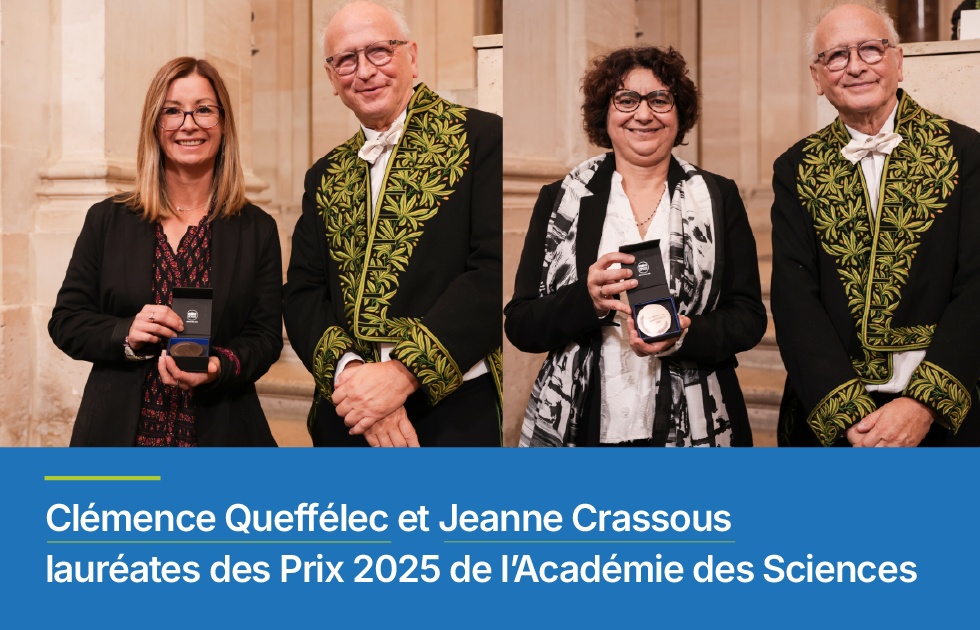
Clémence Queffélec et Jeanne Crassous lauréates des Prix 2025 de l’Académie des Sciences

Le 28 octobre 2025, deux chercheuses du réseau Lumomat , Clémence Queffélec et Jeanne Crassous, ont été récompensées pour leurs travaux lors de la cérémonie des Prix 2025 de l’Académie des Sciences.

Retrouvez la cérémonie de remise de prix sur Youtube :


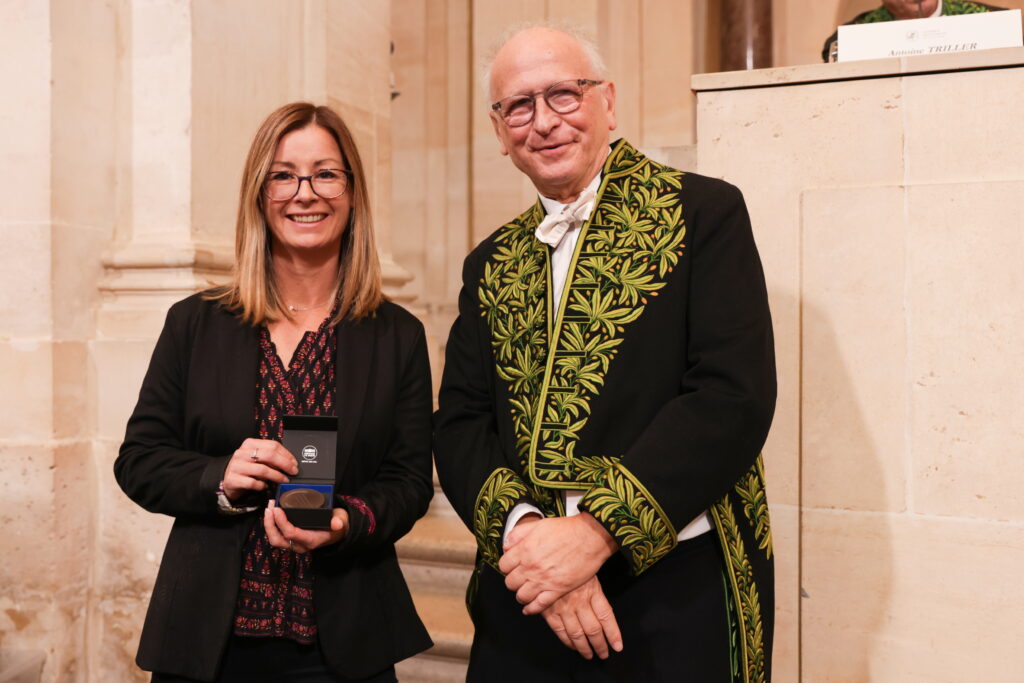
Le prix ARKEMA des sciences de l’innovation en chimie des matériaux durables pour Clémence Queffélec

Clémence Queffélec, Maître de conférences à Nantes University, laboratoire Chimie et interdisciplinarité : synthèse, analyse, modélisation (Ceisam) et responsable du Master 1 Lumomat à Nantes, a obtenu le prix ARKEMA de l’Académie des Sciences.

Le prix (25 000€) créé en 2021 récompense des avancées scientifiques déterminantes dans l’élaboration, la caractérisation, la compréhension ou la mise en œuvre de matériaux durables, c’est- à-dire des matériaux dont le cycle de vie et l’utilisation conduit à un bénéfice environnemental par rapport à l’existant. Ces bénéfices pourraient concerner, par exemple et de façon non exclusive, les bioressources, le recyclage, l’utilisation de matériaux efficaces et légers dans le domaine des énergies renouvelables, de la construction ou de la mobilité durable. En encourageant la recherche sur ces thématiques, le prix souligne la contribution essentielle de la chimie à une économie décarbonée.

Clémence Queffélec s’intéresse à des procédés de valorisation de transformation de la biomasse, de déchets agroalimentaires et industriels en matériaux alternatifs, notamment pour des applications dans les enrobés routiers. En parallèle, elle explore l’usage de la lumière comme source d’énergie pour activer des réactions chimiques ambitieuses.

➖ Retrouvez le portrait de Clémence Queffélec sur le site du CNRS


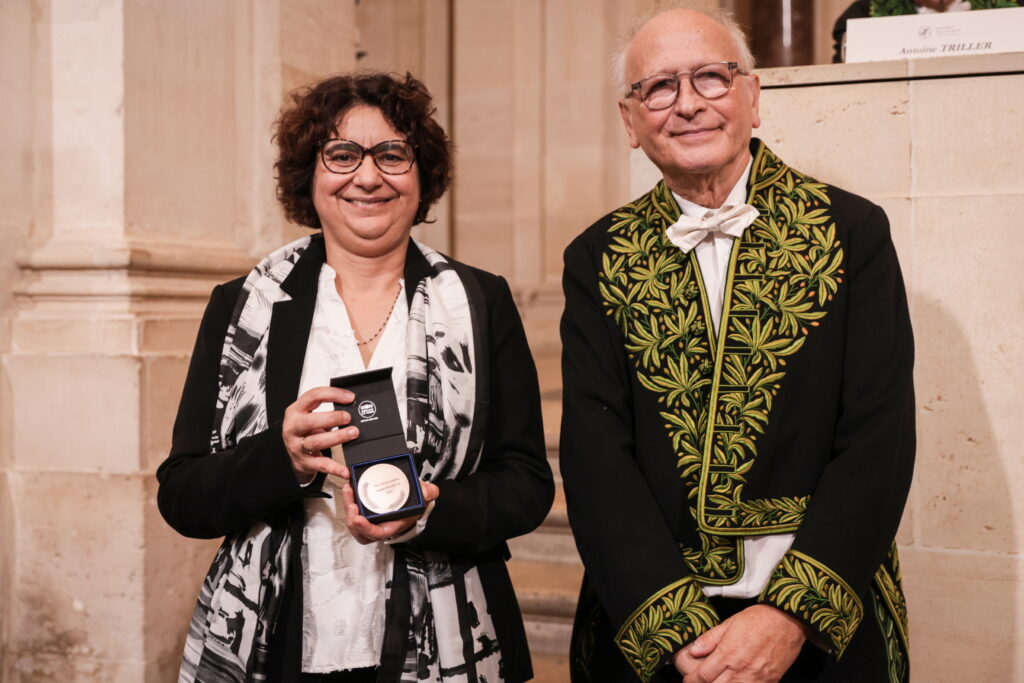
Le prix Clavel-Lespieau pour Jeanne Crassous

Jeanne Crassous, directrice de recherche CNRS à l’Institute of Chemical Sciences of Rennes, intervenante auprès des Masters Lumomat à l’Université de Rennes et d’Angers, a obtenu le prix Clavel-Lespieau de l’Académie des Sciences.

Elle explore les molécules chirales (molécules à images miroir non superposables), depuis leur préparation (hélicènes, complexes organométalliques chiraux), à leurs propriétés photophysiques et chiroptiques (absorption et émission de lumière polarisée), pour la compréhension de processus fondamentaux (violation de parité, effets de spin) et appliqués (diodes à électroluminescence polarisée).

➖ Retrouvez le portrait de Jeanne Crassous sur le site du CNRS

Clémence Queffélec et Jeanne Crassous lauréates des Prix 2025 de l’Académie des Sciences Read More »

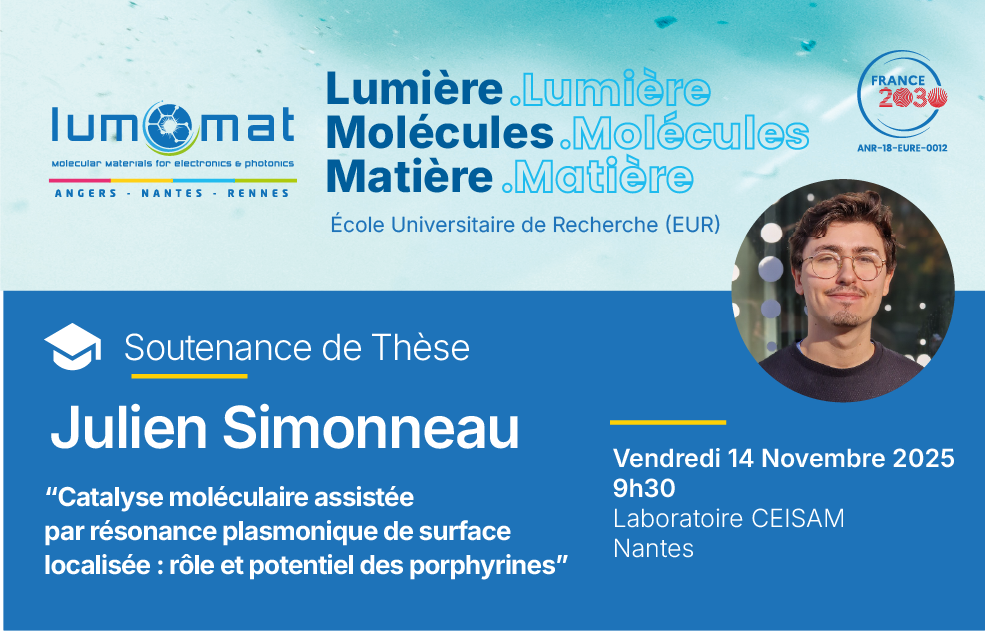
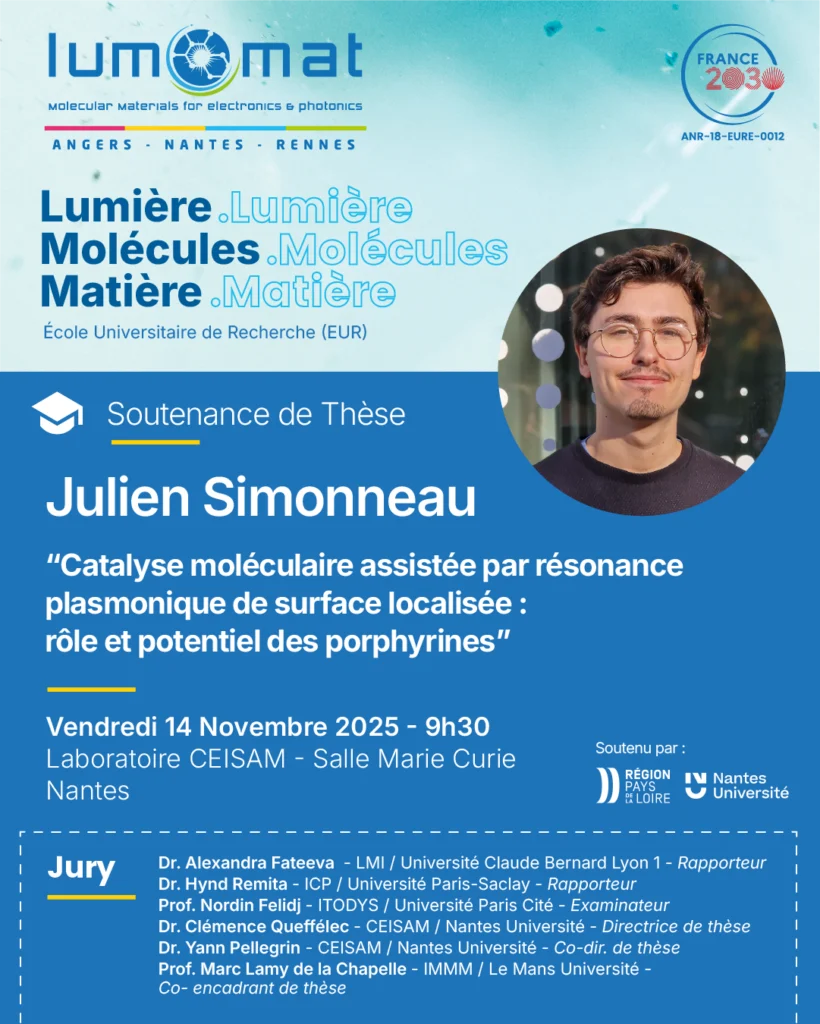
Soutenance de Thèse – Julien Simonneau – Vendredi 14 Novembre 2025: Catalyse moléculaire assistée par résonance plasmonique de surfaces localisées : rôle et potentiel des porphyrines

🎓 Soutenance de Thèse – Julien Simonneau soutiendra sa thèse intitulée : catalyse moléculaire assistée par résonance plasmonique de surfaces localisées : rôle et potentiel des porphyrines
📅 Vendredi 14 Novembre 2025 à 9h30 au Laboratoire CEISAM à Nantes Salle Marie Curie


Cette thèse est dirigée par Dr. Clémence Queffélec – CEISAM / Nantes Université
Jury :
➖ Dr. Alexandra Fateeva – LMI / Université Claude Bernard Lyon 1 – Rapporteur
➖ Dr. Hynd Remita – ICP / Université Paris-Saclay – Rapporteur
➖ Prof. Nordin Felidj – ITODYS / Université Paris Cité – Examinateur
➖ Dr. Yann Pellegrin – CEISAM / Nantes Université – Co-directeur de thèse
➖ Prof. Marc Lamy de la Chappelle – IMMM / Le Mans Université – Co-encadrant de thèse

Cette thèse est soutenue par la Région Pays de La Loire et Nantes Université.

📄 Résumé : Les matériaux plasmoniques, tels que les nanoparticules (NPs) d’or plasmoniques, constituent des matériaux très pertinents en catalyse car ils présentent des propriétés plasmoniques intéressantes sous irradiation lumineuse. La résonance plasmonique de surface localisée (LSPR) correspond à une oscillation collective des électrons libres confinés dans les NPs métalliques, induite par l’interaction avec la lumière. Ce phénomène peut avoir plusieurs effets sur l’environnement local, tels qu’une augmentation locale du champ électromagnétique, une élévation de la température ou encore la génération d’électrons chauds.


🎓 Thesis Defense – Julien Simonneau will defend her PhD thesis: molecular catalysis assited by localised surface plasmon resonance: role and potential of porphyrins
📅 Friday November 14th 2025 at 9:30 at the CEISAM Laboratory in Nantes

This thesis is supervised by Dr. Clémence Queffélec – CEISAM / Nantes Université
Examining Committee :
➖ Dr. Alexandra Fateeva – LMI / Université Claude Bernard Lyon 1 – Reviewer
➖ Dr. Hynd Remita – ICP / Université Paris-Saclay – Reviewer
➖ Prof. Nordin Felidj – ITODYS / Université Paris Cité – Examiner
➖ Dr. Yann Pellegrin – CEISAM / Nantes Université – Thesis co-supervisor
➖ Prof. Marc Lamy de la Chappelle – IMMM / Le Mans Université – Thesis co-supervisor

This thesis is supported by Région Pays de La Loire et Nantes Université.

📄 Abstract: Plasmonic material such as gold plasmonic nanoparticles (NPs) are highly relevant materials for catalysis since they present interesting plasmonic properties under light exposure. The localized surface plasmon resonance (LSPR) is a collective oscillation of the free electrons confined inside metallic NPs induced by the interaction with light which generates highly excited electrons. It can have several effects on the local environment such as inducing a local increase of the electromagnetic field and the temperature or generating hot electrons.

Soutenance de Thèse – Julien Simonneau – Vendredi 14 Novembre 2025: Catalyse moléculaire assistée par résonance plasmonique de surfaces localisées : rôle et potentiel des porphyrines Read More »

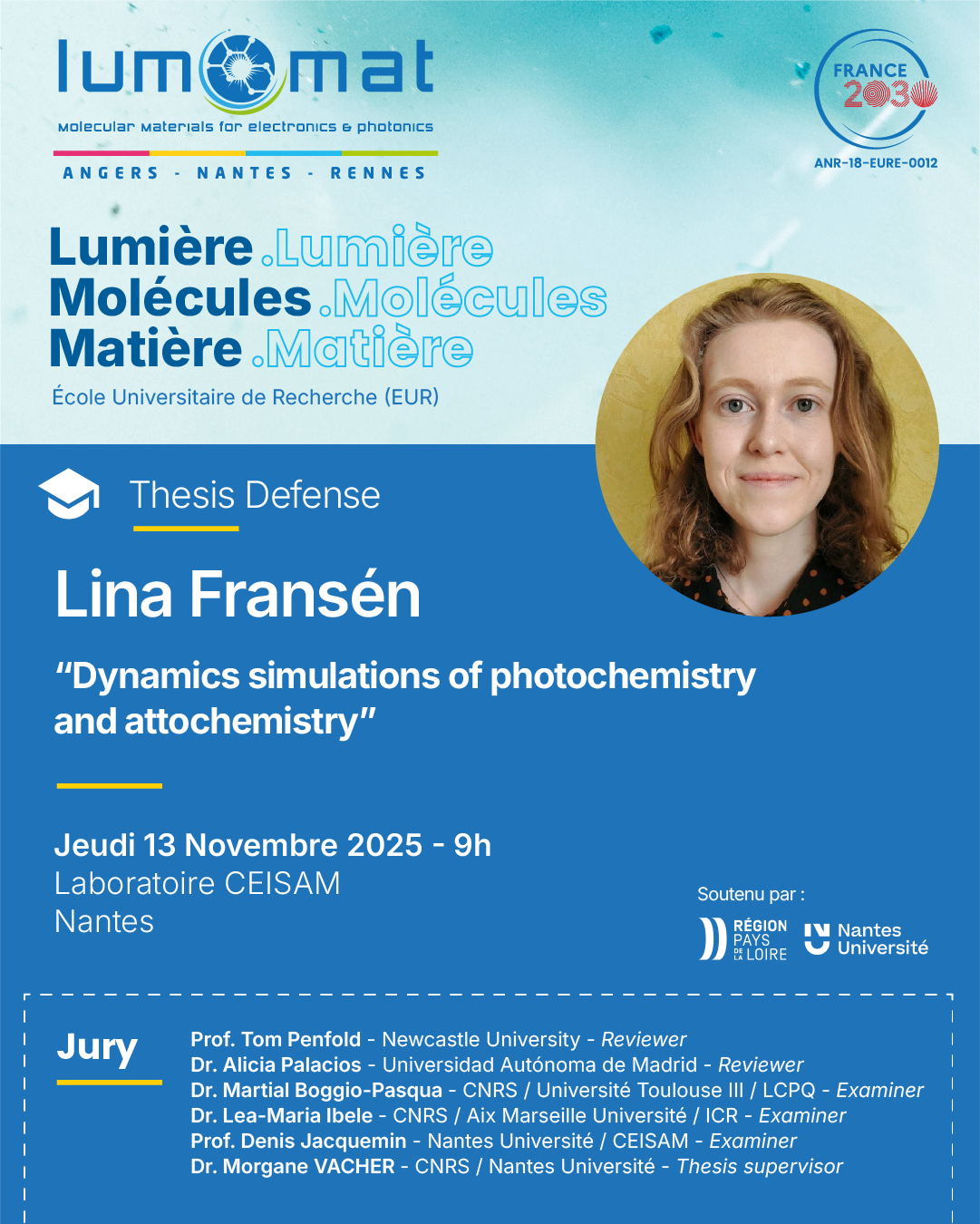
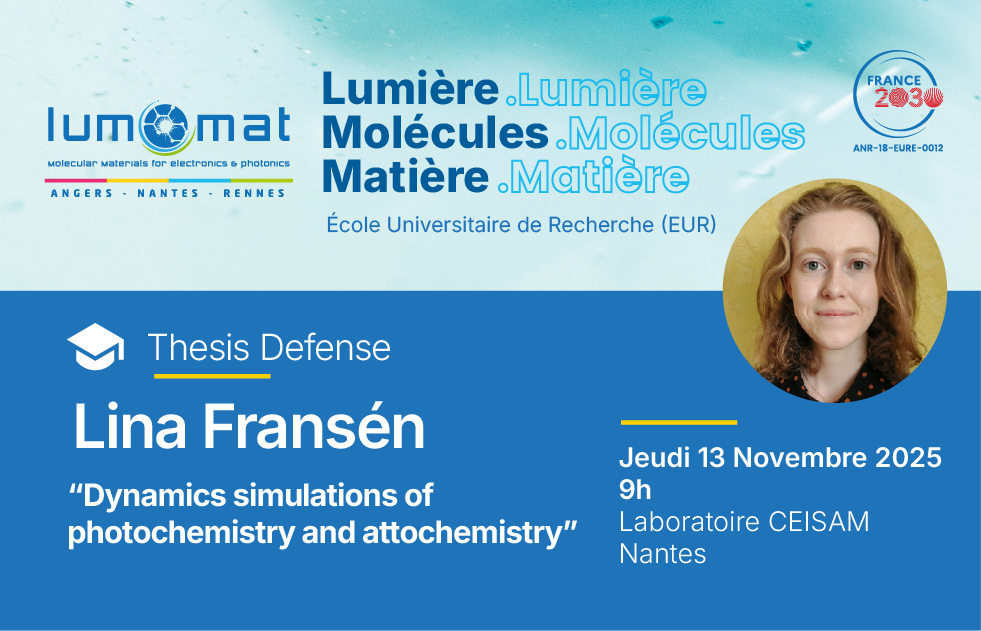
Thesis Defense – Lina Fransén – Thursday November 13th 2025: Dynamics simulations of photochemistry and attochemistry

🎓 Thesis Defense – Lina Fransén will defend her PhD thesis: dynamics simulations of photochemistry and attochemistry
📅 Thursday November 13th 2025 at 9:00 at the CEISAM Laboratory in Nantes


This thesis is supervised by Dr. Morgane Vacher – CNRS / Nantes Université
Examining Committee :
➖ Prof. Tom Penfold – Newcastle University – Reviewer
➖ Dr. Alicia Palacios – Universidad Autonoma de Madrid – Reviewer
➖ Dr. Martial Boggio-Pasqua – CNRS / Université Toulouse III / LCPQ – Examiner
➖ Dr. Lea-Maria Ibele – CNRS / Aix Marseille Université / ICR – Examiner
➖ Prof. Denis Jacquemin – Nantes Université / CEISAM – Examiner

This thesis is supported by Région Pays de La Loire et Nantes Université.

📄 Abstract: This thesis presents theoretical studies of photoinduced coupled electron-nuclear dynamics in organic molecules. It addresses (i) “traditional” photochemistry and photophysics, defined here as the dynamics triggered by the excitation of a single electronic state using a femtosecond laser pulse, and (ii) attochemistry, defined as the dynamics triggered by the excitation of a coherent superposition of multiple electronic states using a shorter-in-time, broader-in-energy attosecond pulse.


🎓 Soutenance de Thèse – Lina Fransén soutiendra sa thèse intitulée : simulations dynamiques de photochimie et attochimie
📅 Jeudi 13 Novembre 2025 à 9h au Laboratoire CEISAM à Nantes

Cette thèse est dirigée par Dr. Morgane Vacher – CNRS / Nantes Université
Jury :
➖ Prof. Tom Penfold – Newcastle University – Rapporteur
➖ Dr. Alicia Palacios – Universidad Autonoma de Madrid – Rapporteur
➖ Dr. Martial Boggio-Pasqua – CNRS / Université Toulouse III / LCPQ – Examinateur
➖ Dr. Lea-Maria Ibele – CNRS / Aix Marseille Université / ICR – Examinateur
➖ Prof. Denis Jacquemin – Nantes Université / CEISAM – Examinateur

Cette thèse est soutenue par la Région Pays de La Loire et Nantes Université.

📄 Résumé : Cette thèse présente des études théoriques sur la dynamique couplée électron-noyau induite par photo-excitation dans des molécules organiques. Elle aborde (i) la photochimie et la photophysique “traditionnelles”, définies ici comme la dynamique déclenchée par l’excitation d’un seul état électronique par une impulsion laser femtoseconde, et (ii) l’attochimie, définie comme la dynamique déclenchée par l’excitation d’une superposition cohérente de plusieurs états électronique par une impulsion attoseconde plus courte temporellement et plus large en énergie.

Thesis Defense – Lina Fransén – Thursday November 13th 2025: Dynamics simulations of photochemistry and attochemistry Read More »

Lumomat 2025 Doctoral Excellence and Distinction Scholarships for Doctoral Students

Le projet LUMOMAT lance la quatrième édition de son financement « Bourses d’attractivité et bourses de distinction doctorale » à destination des doctorants dans les laboratoires partenaires du projet EUR LUMOMAT.

Dépôt de dossier pour les bourses Lumomat jusqu’au 6 Novembre 2025

Tous les doctorants travaillant sur une thématique LUMOMAT et démarrant leur première ou leur troisième année de thèse peuvent déposer un dossier jusqu’au 6 novembre 2025 à 12h.

Conditions d’attribution des bourses Lumomat

La bourse d’attractivité – 1ère année de thèse

La bourse d’attractivité est une bourse d’excellence attribuée aux doctorants démarrant leur première année de thèse. Elle est cumulable avec tous les autres financements de l’EUR Lumomat.

Scholarship amount : 2500€

Conditions d’attribution :

  • Very good academic results (grades M1 and M2)
  • Résumé
  • Cover letter
  • Certified LUMOMAT label
La bourse de distinction doctorale – 3ème année de thèse

La bourse de distinction doctorale est une bourse d’excellence attribuée aux doctorants démarrant leur troisième année de thèse. Elle est cumulable avec tous les autres financements de l’EUR Lumomat.

Scholarship amount : 3500€

Conditions d’attribution :

  • Very good academic results (grades M1 and M2)
  • Dossier scientifique qui comprend le projet de thèse, les publications, les communications orales, les participations à des conférences, les premiers résultats scientifiques, l’implication dans la vulgarisation scientifique, etc.
  • Résumé
  • Cover letter
  • Certified LUMOMAT label

Toutes les informations sont disponibles sur la page: https://lumomat.fr/financements/ dans la catégorie Doctorants.

Lumomat 2025 Doctoral Excellence and Distinction Scholarships for Doctoral Students Read More »

EUR Lumomat supports the JCO 2025 – Organic Chemistry Days / Journées de la Chimie Organique

L’École Universitaire de Recherche Lumomat soutient en tant que sponsor les JCO 2025 – Organic Chemistry Days / Journées de la Chimie Organique organisées par la Société Chimique de France (French Chemical Society). Elles se déroulent du 29 au 31 octobre 2025 à l’Ecole Polytechnique à Palaiseau en France.


Les JCO 2025 – le rendez-vous de la chimie organique

Les JCO – Organic Chemistry Days / Journées de la Chimie Organique sont organisées tous les 3 ans par la division chimie organique de la Société Chimique de France. Elles ont pour but de rassembler les chimistes organiques du monde autour de leurs recherches scientifiques.

Cette année, le colloque inclut 8 plénières et 9 conférences invitées avec des chercheurs français et internationaux du milieu académique et industriel mais aussi des lauréats et lauréates du prix de la Division de Chimie Organique.  

Des sessions de communication orales et de posters pour les jeunes chercheuses et chercheurs sont organisées sur les sujets suivants : catalyse, chimie durable, chimie supramoléculaire, nouvelles méthodes en synthèse organique, chimie appliquée à la médecine, chimie bioorganique, chémobiologie, synthèses complètes de produits naturels, applications pour les matériaux et l’énergie.


Les JCO 2025 – le programme des Journées de la Chimie Organique

L’EUR Lumomat est fière via son soutien financier de participer à ce congrès scientifique incontournable de la cherche sur la chimie organique française et internationale qui favorise le partage des connaissances et la collaboration entre chercheurs et chercheuses.

Les conférenciers et conférencières :

  • Edward Anderson – University of Oxford
  • Thorsten Bach – Technical University of Munich
  • Tatiana Besset – University of Rouen-Normandie – Lauréate du Prix JM Lehn 2025
  • Nessa Carson – AstraZeneca
  • Ben L. Feringa – University of Groningen – Prix Nobel de Chimie 2016
  • Lilian Geniller – University of Montpellier – Lauréate du Prix Dina Surdin 2025
  • Clément Ghiazza – University of Versailles St-Quentin – Lauréat du Prix M. Julia 2025
  • Laurence Grimaud – École Normale Supérieure (ENS) Paris
  • John F. Hartwig – University of California, Berkeley
  • Ohyun Kwon – University of California, Los Angeles
  • Cornelia Meinert – Côte d’Azur University
  • Anat Milo – Ben-Gurion University of the Negev
  • Sophie Rousseaux – University of Toronto
  • Matthieu Sollogoub – Sorbonne University
  • Hiroaki Suga – University of Tokyo
  • Zhiwei Zuo – Shanghai Institute of Organic Chemistry

Retrouvez le programme des journées : https://jco2025.com/wp-content/uploads/2025/10/JCO-2025-detailed-program.pdf


Organiser un congrès avec le soutien financier de l’EUR Lumomat

Si vous souhaitez organiser un congrès avec le soutien financier de l’EUR LUMOMAT, vous pouvez compléter le dossier dédié disponible sur le site web dans la catégorie Permanents / Soutien à l’organisation de congrès : https://lumomat.fr/financements

EUR Lumomat supports the JCO 2025 – Organic Chemistry Days / Journées de la Chimie Organique Read More »

Soutenance de Thèse – Clémence Cazals – Vendredi 17 Octobre 2025: Pérovskites halogénées et matériaux hybrides luminescents à fusion congruente

🎓 [SOUTENANCE DE THESE] – Le mois dernier Clémence Cazals a soutenu avec succès sa thèse intitulée : 🔬 Pérovskites halogénées et matériaux hybrides luminescents à fusion congruente . Félicitations à elle !


Cette thèse était dirigée par Prof. Nicolas Mercier de l’université d’Angers
Jury :
➖ Dr. Dmitry Aldakov – CEA Grenoble – Rapporteur
➖ Dr. George Volonakis – Université de Rennes – Rapporteur
➖ Prof. Emmanuelle Deleporte – ENS Paris-Saclay – Examinatrice
➖ Dr. Sandrine Perruchas – Nantes Université – Examinatrice
➖ Dr. Romain Gautier – Nantes Université – Co-encadrant de thèse

📄 [Résumé] Les pérovskites hybrides suscitent un intérêt croissant en optoélectronique en raison de leurs remarquables propriétés de photoluminescence. Toutefois, la plupart des pérovskites hybrides sont composées de plomb étant toxique (composé CMR (Cancérigène, Mutagène et/ou Reprotoxique)) ce qui limite leur développement à grande échelle. Cette thèse est dédiée à l’élaboration de matériaux hybrides halogénés luminescents à fusion congruente en priorisant les matériaux sans plomb comme les iodocuprates. Le travail s’articule autour de plusieurs axes : (i) l’étude structurale et d’émission de phases pérovskites hybrides au plomb, y compris des polymorphes et des synthèses à l’état fondu via un robot automatisé ; (ii) l’élaboration de nouveaux iodocuprates à structures 1D et 2D montrant des émissions dépendantes de la longueur d’onde d’excitation ; (iii) la synthèse de matériaux hybrides 0D à base de cuivre(I) et d’indium(III), et enfin (iv) l’investigation de phases chirales pour leurs propriétés de photoluminescence circulairement polarisée (CPL). Ces travaux contribuent à la compréhension des relations structure-propriétés et ouvrent la voie à de nouveaux matériaux durables, non toxiques et performants pour des applications dans l’éclairage et l’affichage.


🎓 [THESIS DEFENSE] – Last month Clémence Cazals defended her thesis :
🔬 Luminescent halide perovskites hybrid materials with congruent melting property This thesis was supervised by Prof. Nicolas Mercier by University of Angers. Congratulations!

Examining Committee :
➖ Dr. Dmitry Aldakov – CEA Grenoble – Reviewer
➖ Dr. George Volonakis – Université de Rennes – Reviewer
➖ Prof. Emmanuelle Deleporte – ENS Paris-Saclay – Examiner
➖ Dr. Sandrine Perruchas – Nantes Université – Examiner
➖ Dr. Romain Gautier – Nantes Université – Thesis co-supervisor

Soutenance de Thèse – Clémence Cazals – Vendredi 17 Octobre 2025: Pérovskites halogénées et matériaux hybrides luminescents à fusion congruente Read More »

Groupe des Masters 1 et 2 Lumomat Intégration 2025

Journée d’intégration des étudiantes et étudiants du Master de chimie Lumomat Septembre 2025

Une journée d’intégration pour les Masters Lumomat à l’Institut des Sciences Chimiques de Rennes

Le vendredi 12 septembre 2025 a eu lieu la journée d’intégration pour les étudiantes et étudiants du Master de chimie Lumomat, au sein de l’Institut des Sciences Chimiques de Rennes, un de nos quatre laboratoires partenaires. La matinée fut rythmée par la présentation de l’Ecole Universitaire de Recherche Lumomat par Muriel Hissler, co-directrice du programme au sein de l’Université de Rennes et celle de l’Institut des Sciences Chimiques de Rennes par son directeur Marc Fourmigué.

Arnaud Fihey, Maitre de Conférence à l’ISCR, a pu partager ses recherches auprès des étudiants lors d’une conférence intitulée « Contribution of Molecular Modelling to research in Light-Matters Interactions – Contribution de la modélisation moléculaire dans la recherche en Interactions Lumière-Matières »

Ce fut aussi une opportunité donnée aux étudiantes et étudiants de découvrir les parcours inspirants de 4 diplômés de Lumomat afin de leur permettre de se projeter dans leur avenir. Un grand merci pour leurs témoignages à :

  • Elodie Dureau – Doctorante à l’Institut des Sciences Chimiques de Rennes
  • Bruce Mioko Deme – Ingénieur en Recherche & Développement à Arc en Ciel Sérigraphie
  • Kelvine Letellier – Doctorant à l’Institut des Sciences Chimiques de Rennes
  • Raphaël Burban – Responsable de projet chez Phone recycle Solution – Ingénieur en Physico-Chimie des Matériaux

Pour finir une partie d’Escape Game à Escape Yourself Rennes a permis aux étudiantes et étudiants de Master 1 et 2 de se rencontrer et tisser des liens.

Bonne rentrée à toutes et tous !


Integration day for Lumomat Master’s students at the Rennes Institute of Chemical Sciences

On Friday September 12, took place the integration day for the Master’s students in Chemistry Lumomat at the Rennes institute of Chemical Sciences, one of our partner laboratories. Muriel Hissler, co-director of the Lumomat Graduate School introduced the Lumomat Program and Marc Fourmigué presented the Rennes institute of Chemical Sciences.

Arnaud Fihey, assistant professor at the ISCR, shared his researches to the students with a lecture called « Contribution of Molecular Modelling to research in Light-Matters Interactions »

It was an opportunity for students to discover inspiring professional careers with 4 Lumomat’s graduates. Many thanks again for their testimonials: 

  • Elodie Dureau – PhD student at the Rennes institute of Chemical Sciences
  • Bruce Mioko Deme – R&D engineer at Arc en Ciel Sérigraphie
  • Kelvine Letellier – PhD student at the Rennes institute of Chemical Sciences
  • Raphaël Burban – Project Manager at Phone recycle Solution

At the end of the day, escape rooms missions gathered 1st and 2nd years’ Master students for making connections.

Journée d’intégration des étudiantes et étudiants du Master de chimie Lumomat Septembre 2025 Read More »

See our LUMOMAT academic brochure

X
en_GBENG