
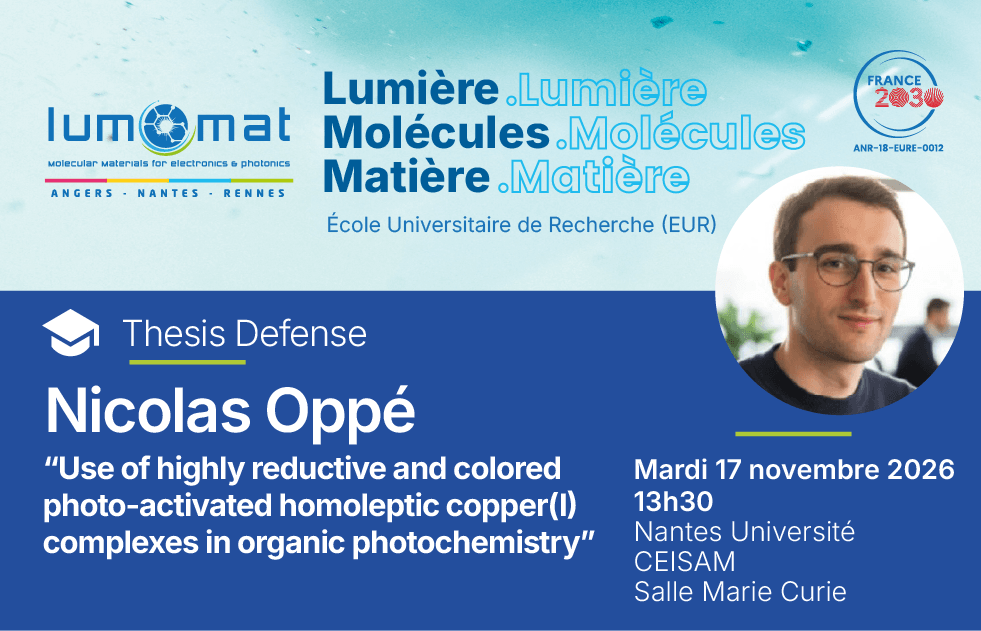
🎓 [THESIS DEFENSE] – Nicolas Oppé will defend his PhD thesis:
🔬 “Use of highly reductive and colored photo-activated homoleptic copper(I) complexes in organic photochemistry”
📅 Tuesday 17 November 2026 at 13:30 – CEISAM Salle Marie Curie This thesis is labelled by EUR LUMOMAT
This thesis is supervised by Dr. Yann PELLEGRIN – CNRS /CEISAM – Nantes Université, Dr. Clémence QUEFFÉLEC – CEISAM – Nantes Université and Dr. Errol BLART – CEISAM – Nantes Université
Examining Committee :
➖ Dr. Aline NONAT – Université de Strasbourg – Reviewer
➖ Prof. Sylvain GAILLARD – Université Claude Bernard Lyon 1 – Reviewer
➖ Dr. Gilles ULRICH – Université de Strasbourg – Examiner
➖ Prof. Cécile MOUCHERON – Université Libre de Bruxelles – Examiner
➖ Dr. Matthieu JEANTY – Director of Synthetic Chemistry – Novalix – Invited Member
📄 [Abstract] This thesis focuses on the synthesis and study of novel homoleptic copper(I) complexes with enhanced reducing power. These complexes are based on a dipp ligand (dipp = 2,9-diisopropyl-1,10-phenanthroline) substituted at the 3,8- or 4,7-positions with various electron-donating groups, in order to investigate the influence of their nature and position on the physicochemical properties of the complexes. The main objective is to shift their reduction potentials towards more negative values, thereby enabling the reduction of substrates with high reduction potentials, such as organochlorine compounds, through reductive quenching (RQ) of their excited states.
The study also focuses on the optimization of a reductive dehalogenation reaction using the [Cu(dipp)₂]⁺ complex, as well as on elucidating its reaction mechanism. The results obtained support the conclusion that this reaction proceeds through a radical mechanism, although the radical species involved have not yet been identified. Finally, the [Cu(dipp)₂]⁺ complex is employed in a carbon–carbon (C–C) coupling reaction between an aryl halide and N-methylpyrrole. The formation of the radical intermediate R• results from the reduction of the C–Br bond by the highly reducing species PS⁻, generated through the reductive quenching (RQ) process.


 FR
 ENG