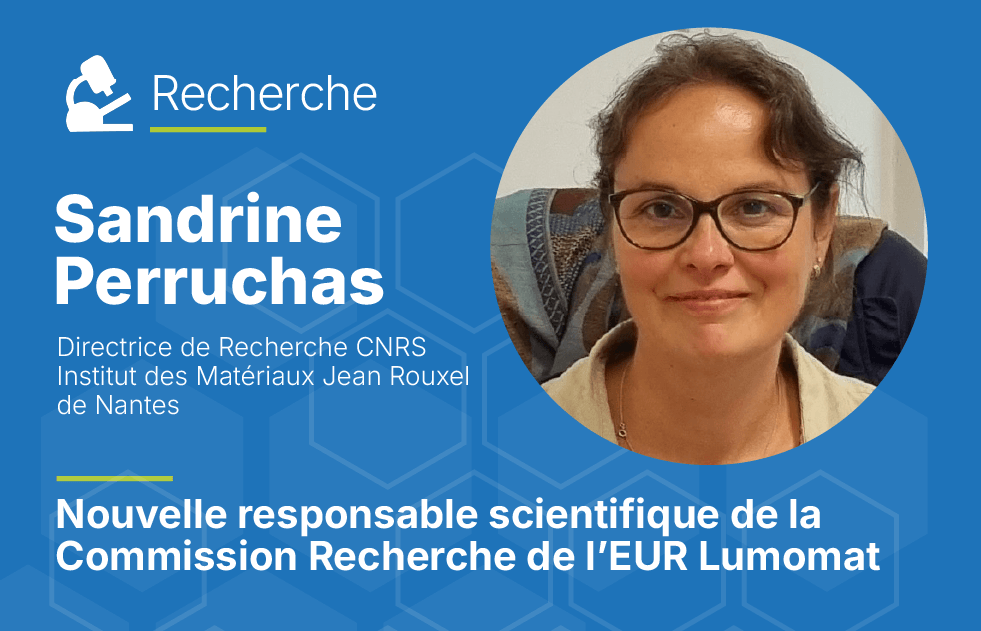
En Mars 2026, Sandrine Perruchas remplace Yann Pellegrin en tant que Responsable Scientifique au sein de la Commission Recherche de l’École Universitaire de Recherche Lumomat.
Yann Pellegrin, directeur de recherche CNRS au CEISAM à Nantes était membre depuis 2022. La Commission Recherche est composé de 3 responsables scientifiques représentant un laboratoire issu des universités partenaires de l’EUR Lumomat.
Sandrine Perruchas est chargée de recherche CNRS à l’Institute of Materials Jean Rouxel of Nantes (IMN) au sein de l’équipe MIOPS – Matériaux Innovants pour l’Optique, le Photovoltaïque et le Stockage.
What is the role of the LUMOMAT Research Committee?
La Commission Recherche constitue l’instance décisionnaire chargée de mettre en œuvre et encadrer la politique scientifique de l’EUR LUMOMAT. À ce titre, elle mène des missions stratégiques destinées à renforcer la dynamique de recherche et à soutenir le développement scientifique de l’EUR.
Its main duties are the following:
Manage scientific project for calls
Ensure the follow-up of funded projects
Décider de l’attribution de financements à destination des doctorants
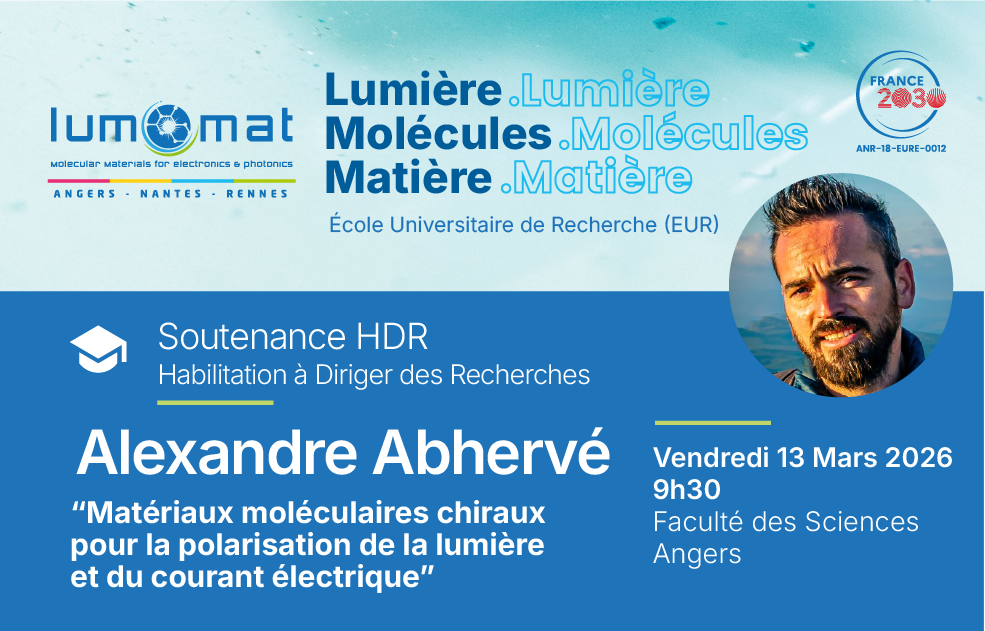
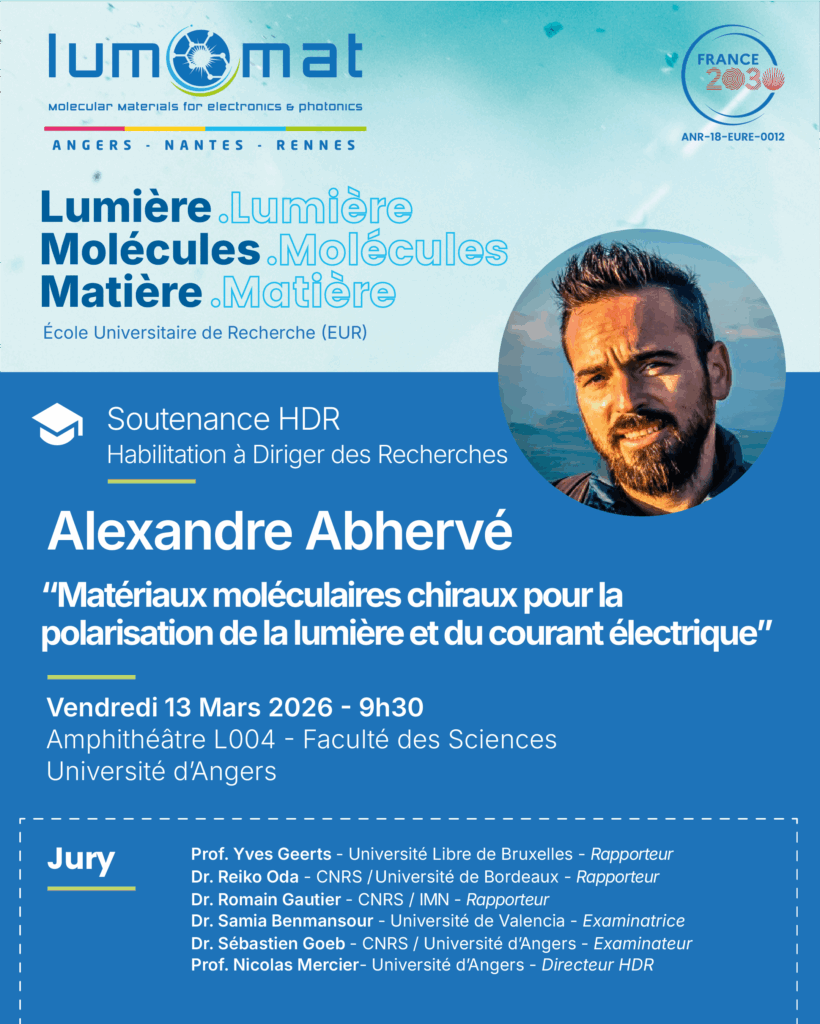
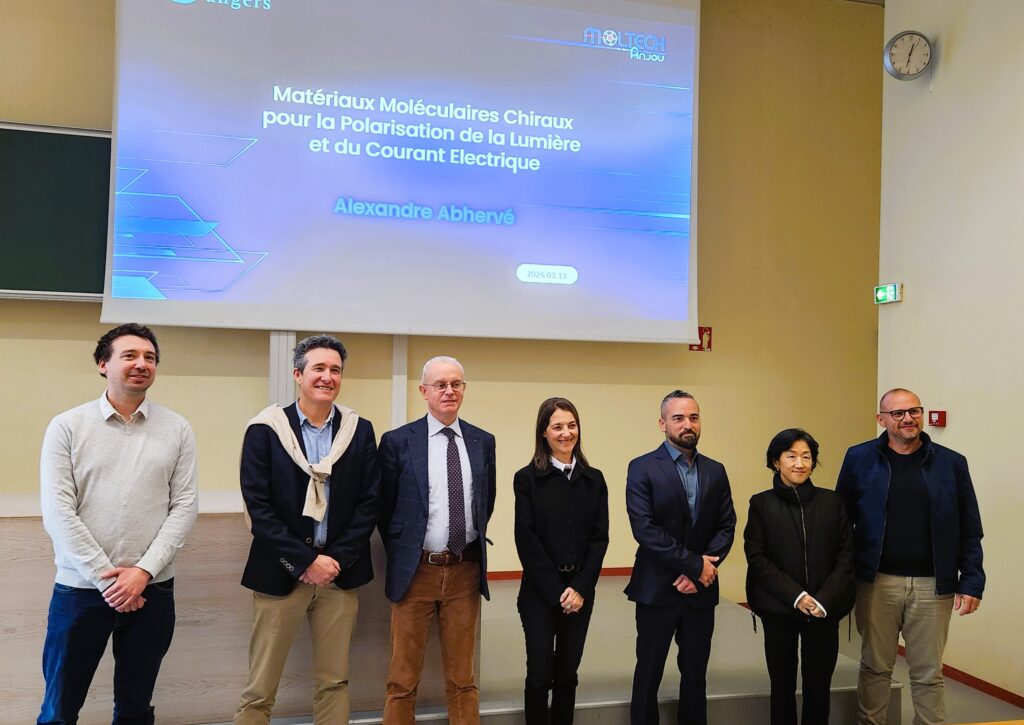
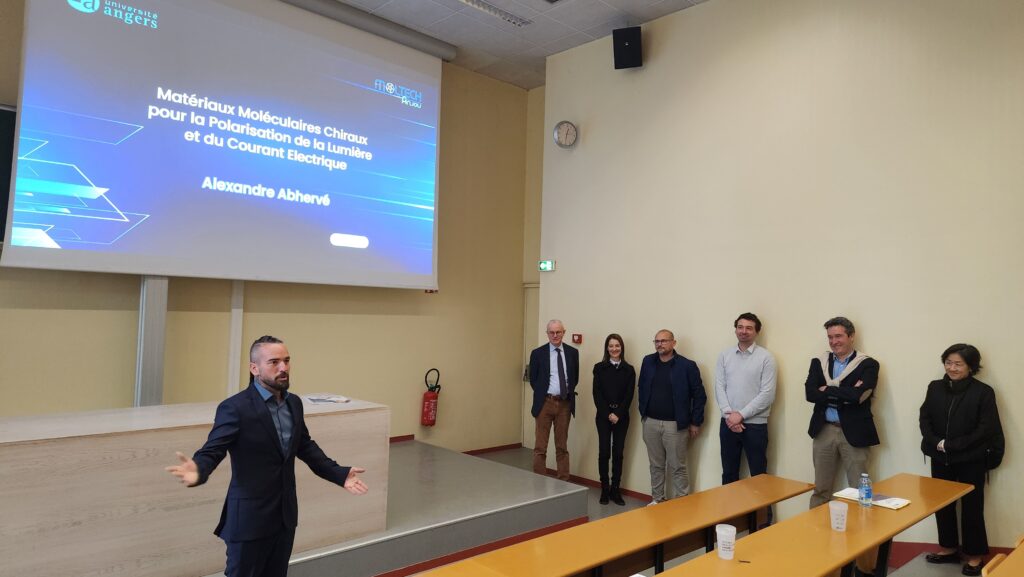
🎓[SOUTENANCE HDR] Le Vendredi 13 Mars 2026 Alexandre Abhervé a passé avec succès sa soutenance HDR – Habilitation à Diriger des Recherches – à l’Université d’Angers au sein du laboratoire Moltech-ANJOU. Elle était intitulée : 🔬Matériaux moléculaires chiraux pour la polarisation de la lumière et du courant électrique. Félicitations à lui !
Prof. Nicolas Mercier de l’Université d’Angers dirigeait cette HDR.
Jury : ➖ Prof. Yves Geerts (Professor, Université Libre de Bruxelles) – Rapporteur ➖ Dr. Reiko Oda (CNRS Research Director, Université de Bordeaux) – Rapporteur ➖ Dr. Romain Gautier (CNRS Research Scientist, Institut des Matériaux de Nantes Jean Rouxel) – Rapporteur ➖ Dr. Samia Benmansour (Associate Professor, Université de Valencia) – Examinatrice ➖ Dr. Sébastien Goeb (CNRS Research Director, Université d’Angers) – Examinateur
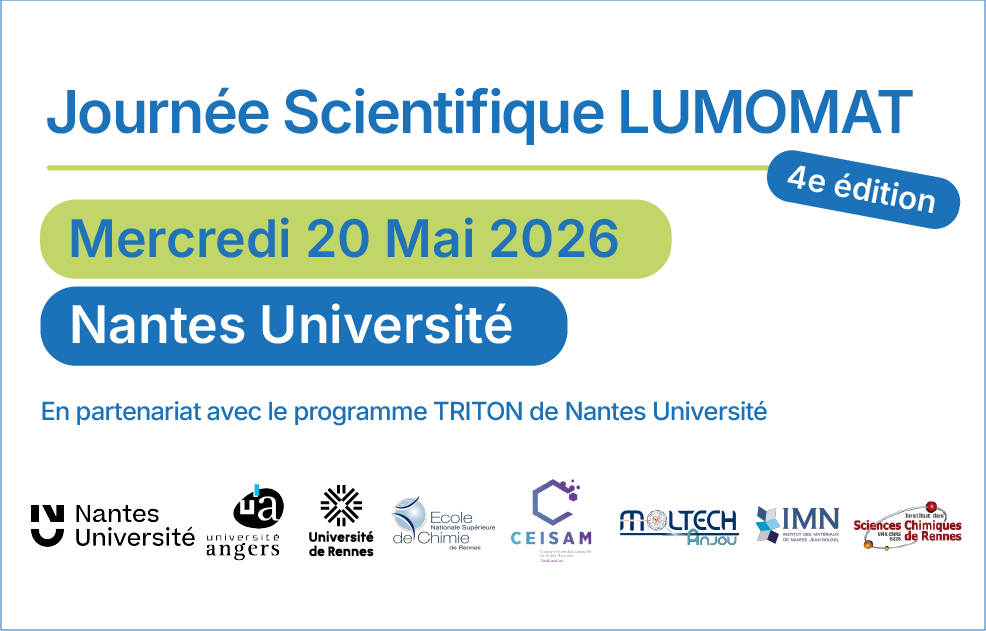
L’École Universitaire de Recherche Lumomat a la plaisir de vous inviter à sa 4èmeJournée Scientifique qui se déroulera le Mercredi 20 Mai 2026 àNantes.
Si vous candidatez également pour une communication orale, merci de déposer votre abstract directement via le formulaire d’inscription. La date limite de soumission des résumés est fixée au 24 Avril 2026.
Modalités d'inscription
L’inscription est obligatoire pour toutes et tous. Pour les doctorants et doctorantes désirant présenter un poster, vous devez simplement l’indiquer lors de votre inscription. Le dépôt d’un abstract est quant à lui réservé exclusivement aux candidats souhaitant effectuer une communication orale.
📜 Inscriptions : jusqu’au Vendredi 24 Avril 2026 ⏰ Deadline pour le dépôt des abstracts : jusqu’au Vendredi 24 Avril 2026
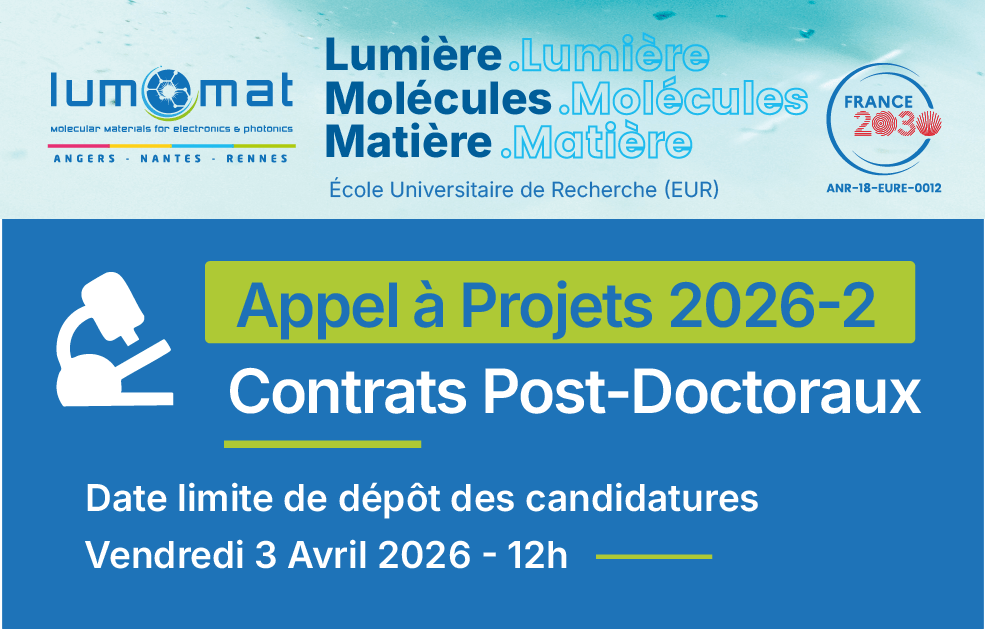
Each year, we launch an internal call for projects on the scientific themes defined within the EUR LUMOMAT project for the funding of doctoral fellowships and postdoctoral contracts.
Les financeurs des 11 demi allocations doctorales du dernier Appel à Projets 2026 sont les suivants : 6 de l’EUR Lumomat, 2 de l’Université d’Angers, 1 pour Nantes Université et 2 pour l’Université de Rennes.
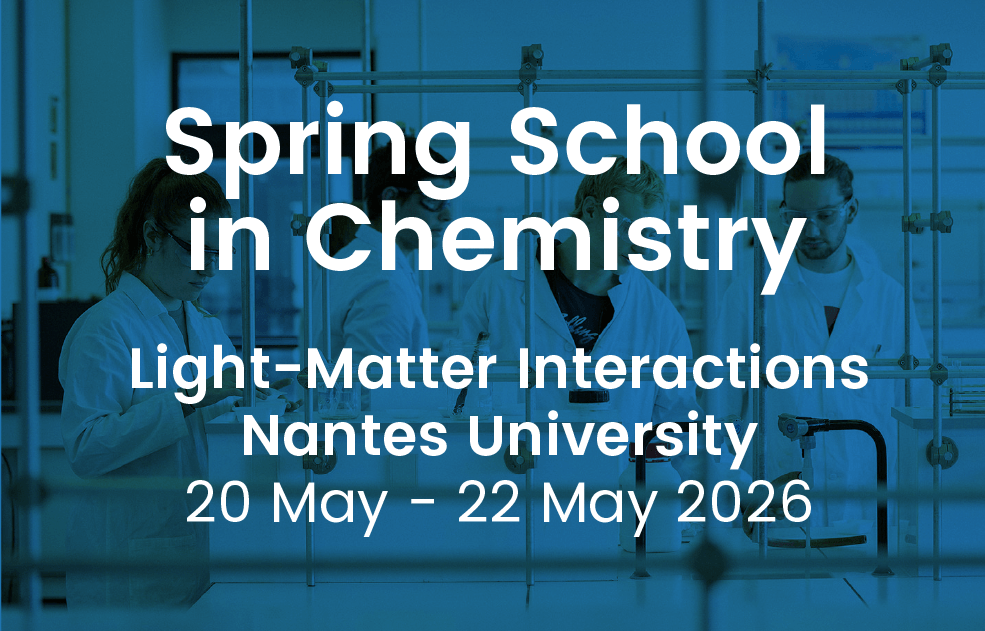
From 20 May 2026 to 22 Mays 2026 – Nantes Organised by TRITON programme – Nantes University
The aim of this Spring School is to provide students with an overview of recent advances and future directions in light–matter interactions.
A program dedicated to bachelor's and master's students
The Spring School is open to bachelor’s (3rd year minimum) or master’s students in chemistry. Knowledge of organic chemistry, spectroscopy, theoretical chemistry and/or electrochemistry is appreciated. Participants will be awarded 1 ECTS upon successful completion of the program.
Enlightening days of chemistry!
A famous quote from the American writer Edith Wharton states that “There are two ways of spreading light: to be the candle or the mirror that reflects it”. The interaction between light and matter has fascinated not only writers but also scientists, and chemists are no exception. Shining light on a molecule or a material can induce remarkable phenomena at the infinitesimal scale of atoms and molecules. Over the past decades, these phenomena have been exploited by chemists in many scientific fields, including energy production, health and environment, the synthesis and characterization of materials for information transport and storage, and the light-induced construction of organic architectures.
During the Spring School LUMOMAT, students and world-class researchers will discuss recent advances and future directions in research fields devoted to light–matter interactions, from theoretical to experimental perspectives. Social events will also be a great way to discover Nantes, one of France’s largest city, which is located near the Atlantic coast and recognized for its culture.
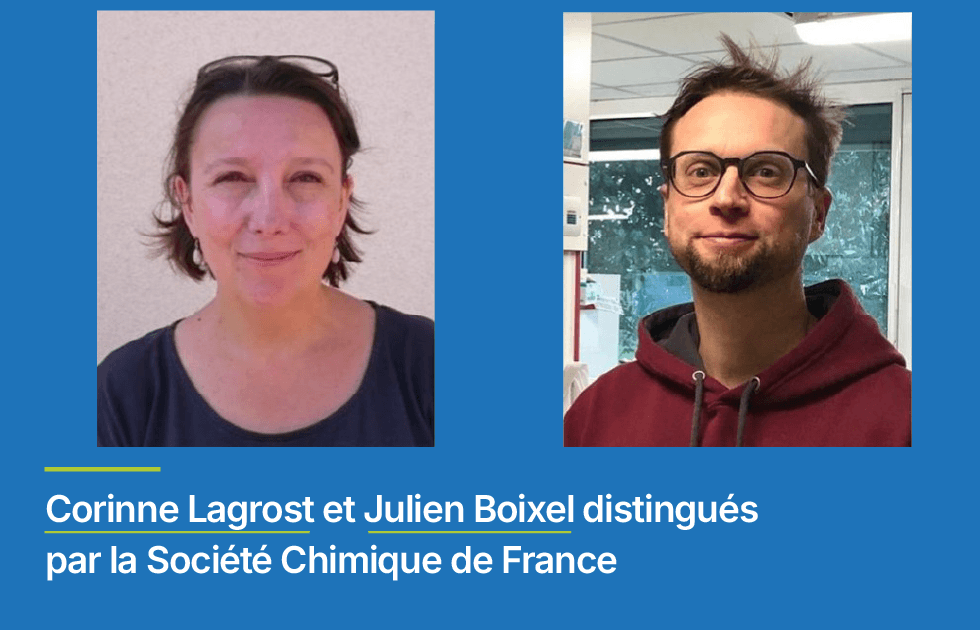
✨🏆 Félicitations à Corinne Lagrost et Julien Boixel qui ont reçu respectivement le titre de “Membre distingué” Senior et Junior de la Société Chimique de France. Ces distinctions récompensent leurs mérites scientifiques et leur implication auprès de la SCF.
Corinne Lagrost et Julien Boixel dirigent actuellement chacun une thèse financée par l’Ecole Universitaire de Recherche Lumomat à l’Institute of Chemical Sciences of Rennes.
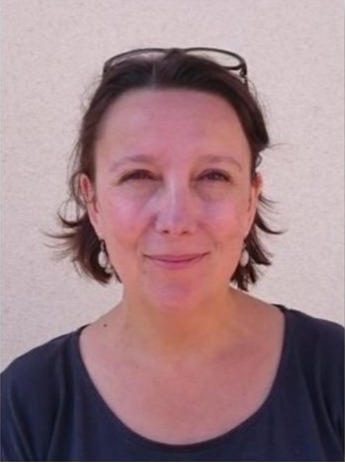
Corinne Lagrost reçoit le titre de "Membre Distingué" Senior de la Société Chimique de France
Corinne Lagrost est actuellement directrice de recherche au CNRS au sein de l’équipe MaCSE de l’Institut des sciences chimiques de Rennes (ISCR). Après une thèse à l’Université Paris-Diderot (aujourd’hui Université Paris Cité) en 2000, une année d’ATER (1999-2000) à l’Université Paris-Diderot et un séjour postdoctoral à l’Université d’Amsterdam (Pays-Bas, 2000-2001), elle a obtenu un poste de chercheuse au CNRS à l’ISCR en 2001.
Les recherches de Corinne Lagrost
Ses recherches portent sur : i) la réactivité électrochimique, notamment dans des milieux non conventionnels tels que les liquides ioniques et les DES (solvants eutectiques profonds) ii) la fonctionnalisation moléculaire de surfaces métalliques ou carbonées, en particulier via la chimie des diazoniums (en vrac ou sur nanoparticules) iii) les processus de réactions électrocatalytiques (HER, ORR, MOR).
Plus récemment, elle s’intéresse à l’exploitation des propriétés plasmoniques de nanocatalyseurs d’or et d’argent en électrocatalyse. Ses travaux ont été soutenus par plusieurs financements et de fructueuses collaborations, et ont conduit à la création d’une spin-off (X4C) avec des collègues belges.
L'implication dans la communauté chimique de Corinne Lagrost
Elle a participé à différents comités au service de la communauté chimique (CNU section 31 – CoCNRS : Conseil scientifique de l’Institut de Chimie du CNRS, CID 52, CID 54 – Conseil d’administration de l’Université de Rennes 1). Elle s’est fortement investie dans la promotion de la culture scientifique.
Elle a rejoint le bureau de la DCP (Division de Chimie Physique) de la SCF et de la sous-division d’Électrochimie en tant que membre élue pour la période 2019-2022 ; elle est ensuite devenue présidente de la sous-division d’Électrochimie en 2022 puis en 2025.
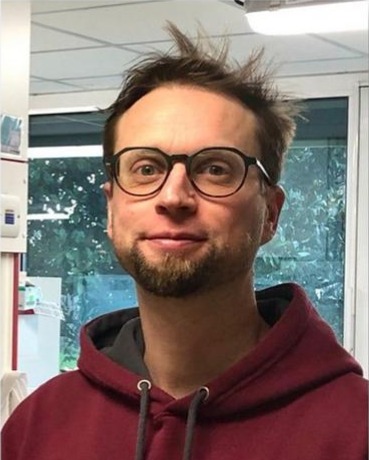
Julien Boixel reçoit le titre de "Membre Distingué" Junior de la Société Chimique de France
Julien Boixel a obtenu son doctorat en chimie organique à l’Université de Nantes en 2009 sous la direction du Dr Fabrice Odobel, travaillant sur des systèmes multichromophores pour la séparation de charges photoinduite. Il a ensuite effectué un postdoctorat avec le Prof. Stefan Matile à l’Université de Genève en chimie supramoléculaire appliquée au photovoltaïque, suivi d’un second postdoctorat à l’ENS Cachan / Institut des Sciences Chimiques de Rennes avec le Dr Keitaro Nakatani et le Dr Véronique Guerchais sur la photochromie de complexes organométalliques.
Les recherches de Julien Boixel
Recruté comme chargé de recherche au CNRS en 2012 à l’ISCR, il a développé en collaboration des complexes de platine(II) cyclométallés et des systèmes à base de diaryléthènes comme plateformes performantes pour le contrôle photochimique réversible de la luminescence et des réponses optiques non linéaires.
Depuis 2019, ses recherches indépendantes s’articulent autour de trois axes complémentaires :
(i) des systèmes supramoléculaires photo‑contrôlés exploitant le mouvement des diaryléthènes,
(ii) des matériaux hybrides organiques–inorganiques intégrant des polyoxométallates photoactifs, et
(iii) la photocatalyse organique et organométallique. À travers ces approches, il conçoit des matériaux moléculaires entièrement optiques et développe des stratégies photochimiques pour le contrôle à distance des propriétés des matériaux.
Son programme actuel vise à faire de la photochromie et de la photophysique moléculaire des outils prédictifs pour l’ingénierie chimique.
L'implication dans la communauté chimique de Julien Boixel
Au‑delà de ses activités de recherche, Julien s’investit activement dans les communautés académiques et chimiques. Il a été trésorier du bureau régional (Bretagne et Pays de la Loire) de la Société Chimique de France (SCF) de 2019 à 2022, et est depuis 2022 trésorier de la subdivision Photochemie, Photophysique et Photosciences (SP2P) de la SCF. Depuis 2024, il est également membre de la Commission Recherche et de la Commission SCD (Service Commun de Documentation) de l’Université de Rennes.
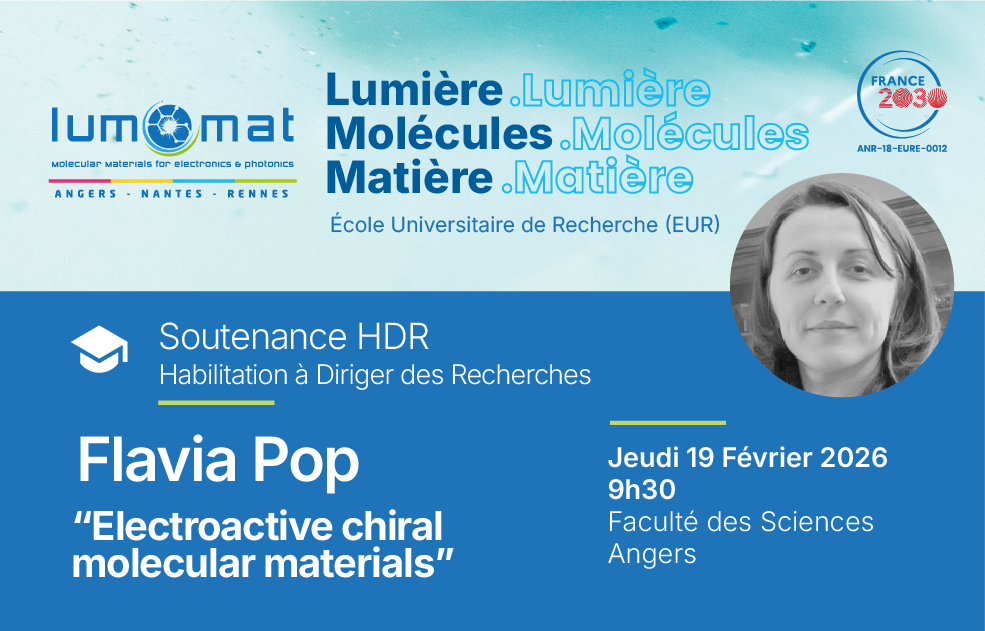
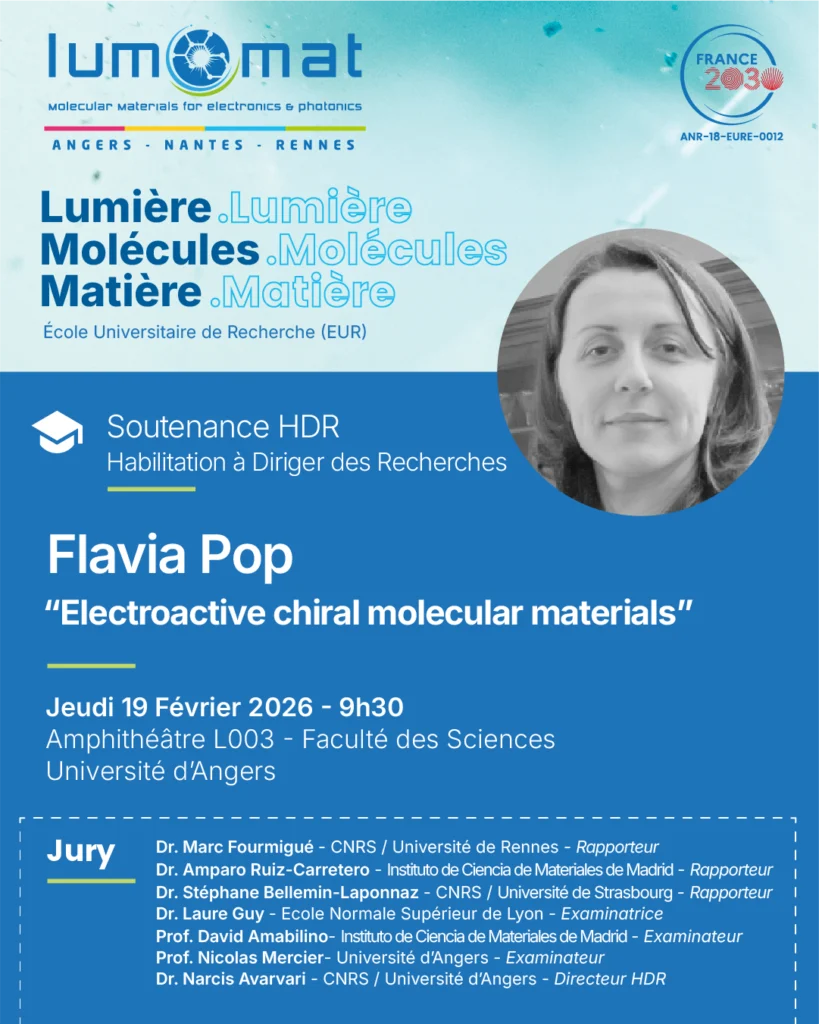
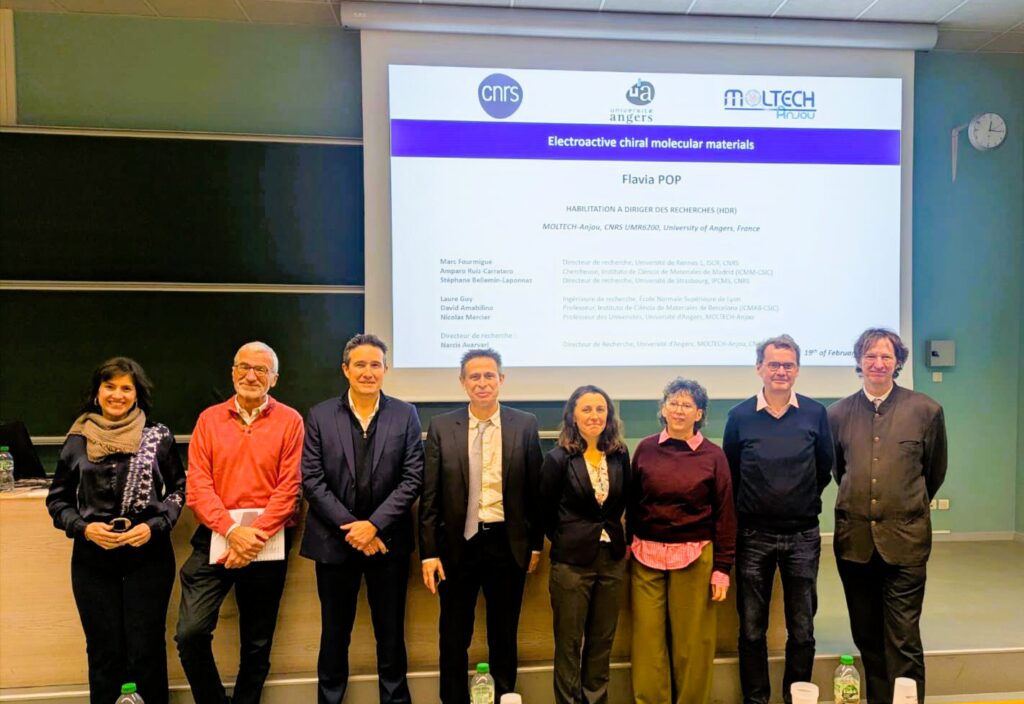
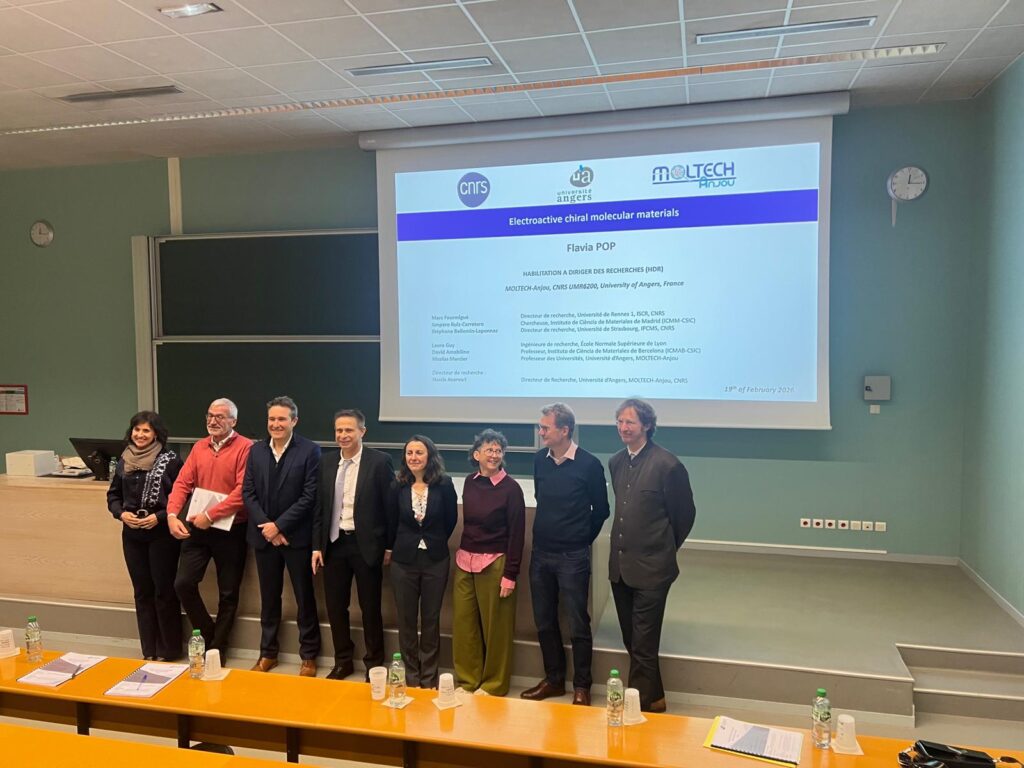
🎓 [SOUTENANCE HDR] Le Jeudi 19 Février 2026 Flavia Pop a passé avec succès sa soutenance HDR – Habilitation à Diriger des Recherches – à l’Université d’Angers au sein du laboratoire Moltech-ANJOU intitulée : 🔬 Electroactive chiral molecular materials. Félicitations à elle !
Cette HDR était dirigée par Dr. Narcis Avarvari de l’Université d’Angers
Jury : ➖Dr. Marc Fourmigué (CNRS Research Director, Université de Rennes 1, ISCR) – Rapporteur ➖ Dr. Amparo Ruiz-Carretero (Research Scientist, Instituto de Ciencia de Materiales de Madrid, ICMM-CSIC) – Rapporteur ➖ Dr. Stéphane Bellemin-Laponnaz (CNRS Research Director, Université de Strasbourg, IPCMS) – Rapporteur ➖ Dr. Laure Guy (Research Engineer, École Normale Supérieure de Lyon) – Examinatrice ➖ Prof. David Amabilino (Professor, Instituto de Ciencia de Materiales de Barcelona, ICMAB-CSIC) – Examinateur ➖ Prof. Nicolas Mercier (Professor, Université d’Angers, MOLTECH-Anjou) – Examinateur
Les candidatures au Cursus Master Ingénierie ou CMI Chimie LUMOMAT (Lumière, Molécules, Matière) pour la rentrée 2026 ouvrent du 19 janvier au 12 mars sur la plateforme https://www.parcoursup.gouv.fr/. Retour sur les spécificités CMI Chimie LUMOMAT et les modalités de candidature.
Les Cursus Master Ingénierie (CMI) sont des formations en 5 ans s’appuyant sur les licences et masters déjà existants à l’Université mais sélectives et plus exigeantes. Ces formations d’excellence comprennent des renforts en sciences humaines et sociales permettant aux étudiants, qui intègrent ces cursus dès le L1, de développer des aptitudes personnelles et professionnelles requises au métier d’ingénieur : autonomie, adaptabilité, aptitude à travailler en équipe et à diriger une équipe, connaissance du monde de l’entreprise dans la société actuelle (structures, législation en vigueur …), et facilitera ensuite leur insertion professionnelle.
C'est quoi le CMI Chimie Lumomat à Angers ?
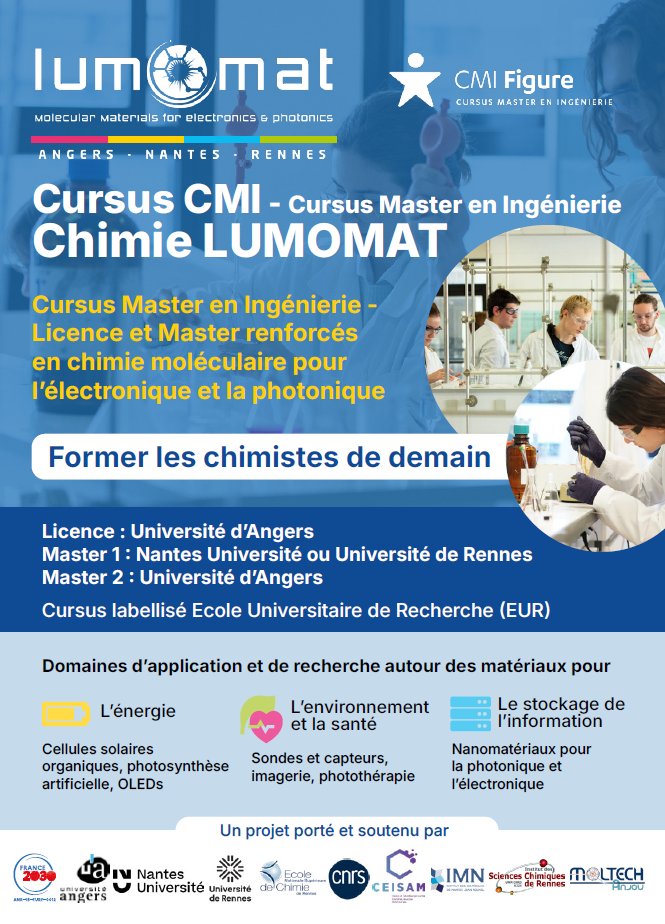
Le CMI Lumomat s’appuie sur la licence MPC / Physique-Chimie and le Master Lumomat (LUmière, MOlécules, MATières) pour former les chimistes de demain. Ce cursus est également labellisé Ecole Universitaire de Recherche (EUR) par l’Agence Nationale de la Recherche.
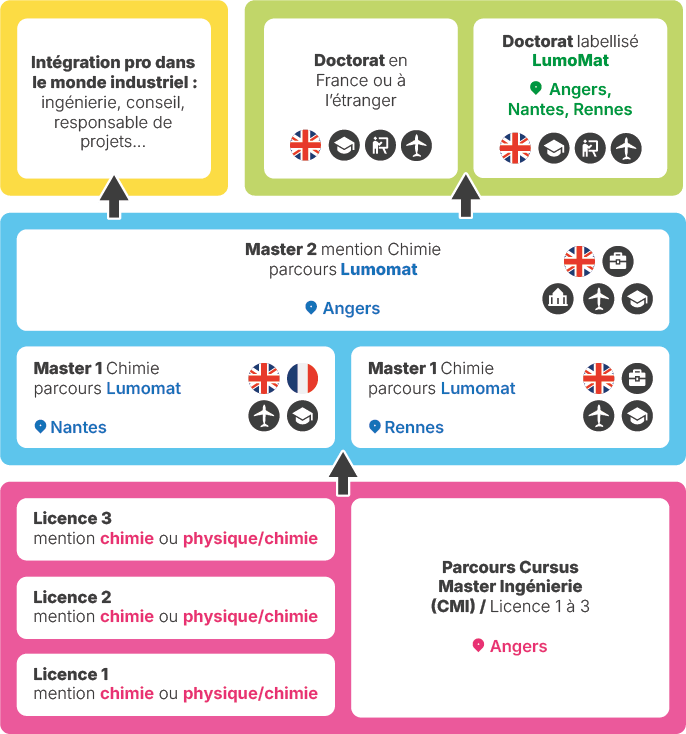
Vous trouverez ci-dessous les schéma des parcours possibles.
Les étudiants en CMI suivent les cours de licence et de master et bénéficient d’activités supplémentaires.
6 ECTS en + chaque semestre
Enseignements scientifiques, de spécialité et transversaux supplémentaires
Petits groupes
Périodes de stages supplémentaires en licence et master, en entreprise et laboratoires de recherche, en France ou à l’étranger
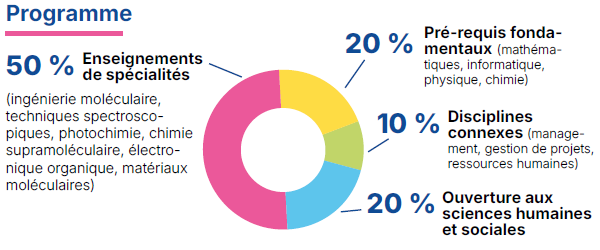
Quel est le programme du CMI Chimie Lumomat ?
Stages, projets tutorés en laboratoire (25% de la formation)
Une expérience à l’international (stage ou semestre d’étude)
A la fin du CMI Lumomat les étudiants et les étudiantes auront des compétences en :
ingénierie moléculaire
synthèse, modélisation et spectroscopie
caractérisations physico-chimiques
fabrication de dispositifs
management de projets
Que font nos diplômés après le Master Lumomat ?
65% poursuivent par une thèse académique ou CIFRE
En continuant le cursus avec un doctorat labellisé Lumomat ou non, au sein de l’un de nos quatre laboratoires partenaires, dans d’autres universités françaises ou internationales, ou en lien avec l’industrie dans le cadre de thèses CIFRE.
35% intègrent le secteur industriel à la sortie du Master
Quelques exemples d’emplois : ingénieur matériaux, technicienne de police scientifique, ingénieure technicocommerciale, ingénieur recherche et développement, chimiste de production…
Comment candidater au Cursus Master Ingénierie Lumomat ?
Profil conseillé : titulaire d’un bac avec une spécialisation en sciences (physique/chimie et maths)
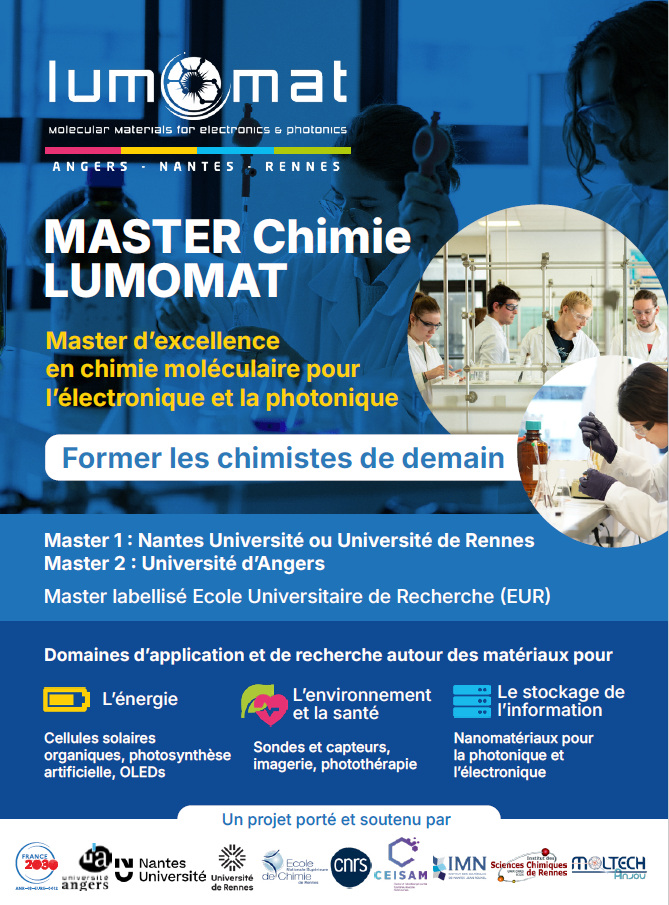
Les candidatures en Master mention Chimie LUMOMAT (Lumière, Molécules, Matière) pour la rentrée 2026 ouvrent du 17 février au 16 mars sur la plateforme https://monmaster.gouv.fr/. Retour sur les spécificités du Master LUMOMAT et les modalités de candidature.
Caractérisations et photonique organique (7 ECTS) – Photophysique et photochimie – Techniques de spectroscopies et microscopies – Interactions lumière-matière pour la biologie – Électrochimie des surfaces modifiées
Unité 5
Matériaux et électronique organique (8 ECTS) – Matériaux moléculaires et hybrides, et nanomatériaux – Électronique organique
Internship
Stage en laboratoire, en entreprise ou dans l’industrie de 4 à 6 mois (30 ECTS)
A la fin du Master Lumomat les étudiants et les étudiantes auront des compétences en :
ingénierie moléculaire
synthèse, modélisation et spectroscopie
caractérisations physico-chimiques
fabrication de dispositifs
management de projets
Candidater en phase principale sur Mon Master
L’accès au Master Lumomat est sélectif, sur étude de dossier. Les candidatures sont réalisées sur la plateforme Mon Master. La procédure se décline en trois principales étapes :
L’étudiant doit créer son compte “Candidat” sur la plateforme. Sur ce compte, dans la rubrique “Mon dossier candidat”, l’étudiant peut renseigner les informations communes pour toutes les formations : état civil, cursus post-baccalauréat, relevés de notes, etc.
Sur la page formation de son choix (Angers, Nantes ou Rennes), l’étudiant complète et transmet les pièces justificatives spécifiques à la formation LUMOMAT en cliquant sur le bouton “Candidater” dans la rubrique “Pour candidater”. Selon l’Université d’inscription, les pièces et informations demandées peuvent varier.
Parmi les pièces demandées, l’étudiant est invité à réaliser gratuitement un test de son niveau d’anglais et à transmettre les résultats sur la plateforme Mon Master.
Étudiants étrangers : comment intégrer la formation Lumomat ?
Les ressortissants des pays européens et hors Europe doivent suivre une procédure spécifique pour candidater en Master Lumomat. Pour trouver toutes les informations nécessaires, rendez-vous sur le site internet Campus France qui détaille les procédures à suivre selon le profil et le lieu de résidence de l’étudiant. Selon le pays de résidence et la procédure de demande d’inscription associée, le calendrier de candidature peut varier.
S’inscrire en deuxième année de Master Lumomat à l’Université d’Angers
Pour intégrer directement la deuxième année de Master Lumomat, les étudiants doivent candidater sur la plateforme eCandidat de l’Université d’Angers. Les dates de candidature pour la rentrée 2026 (mai-juin) seront prochainement publiées dans la rubrique “Offre de formation” de la plateforme.
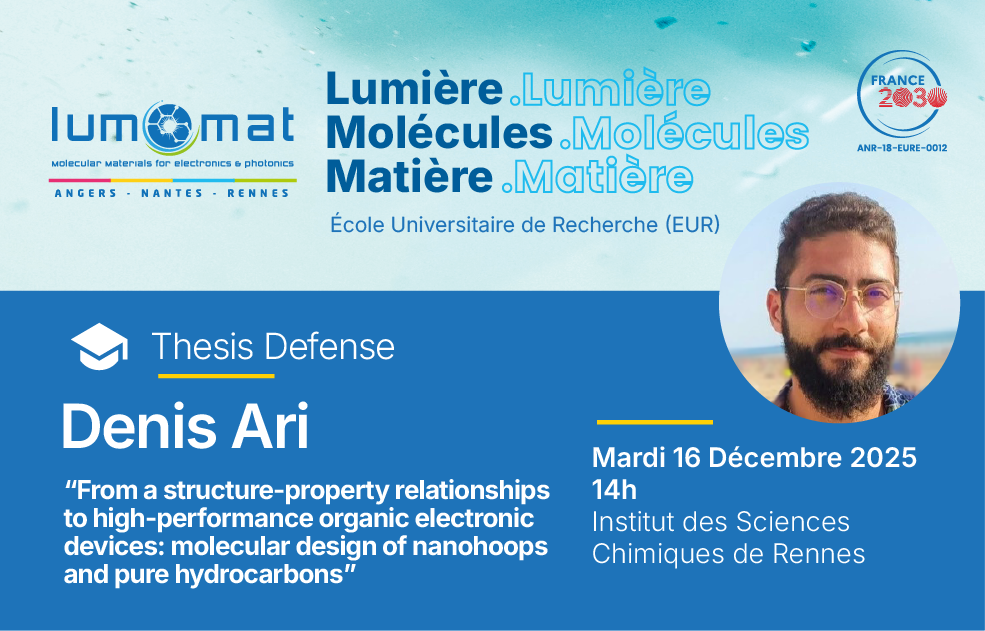
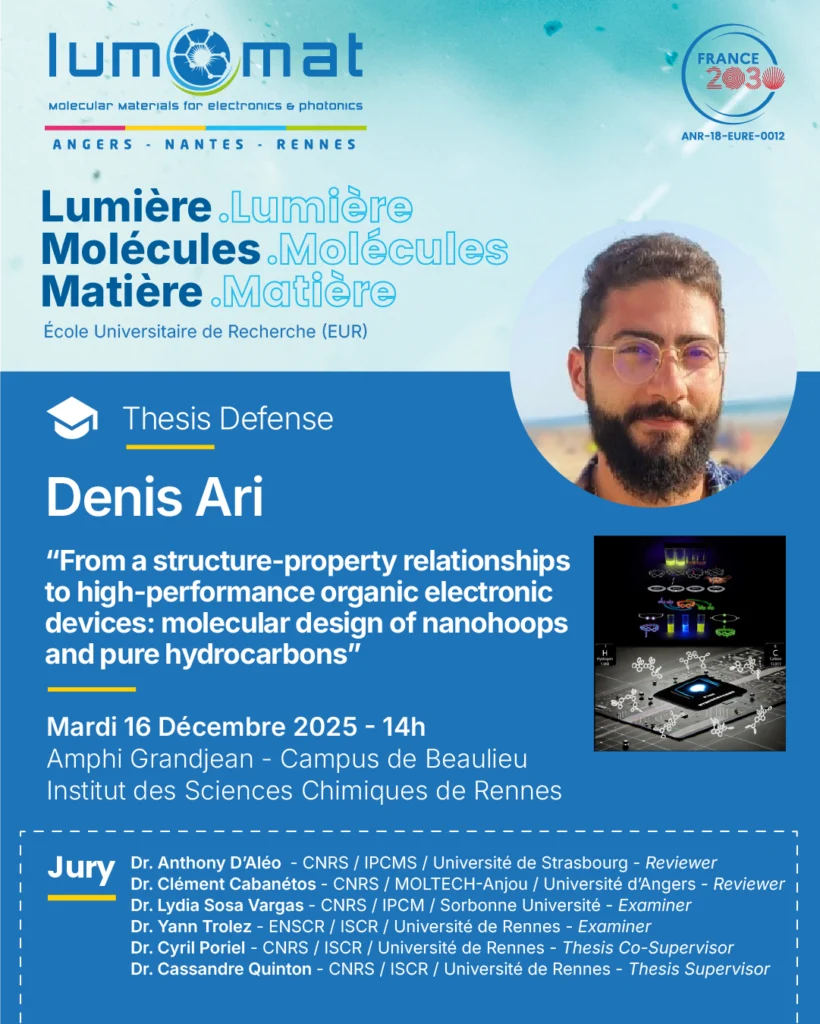
🎓 Thesis Defense – Denis Ari will defend his PhD thesis: from a structure-property relationships to high-performance organic electronic devices: molecular design of nanohoops and pure hydrocarbons 📅 Tuesday December 16th 2025 at 14:00 at the Rennes Institute of Chemical Sciences – Beaulieu Campus – Amphi Grandjean
This thesis is supervised by Dr. Cassandre Quinton – CNRS / ISCR / Université de Rennes Examining Committee : ➖ Dr. Anthony D’Aléo – CNRS/ IPCMS / Université de Strabourg – Reviewer ➖ Dr. Clément Cabanetos – CNRS / MOLTECH-Anjou / Université d’Angers – Reviewer ➖ Dr. Lydia Sosa Vargas – CNRS / IPCM / Sorbonne Université – Examiner ➖ Dr. Yann Trolez – ENSCR / ISCR / Université de Rennes – Examiner ➖ Dr. Cyril Poriel – CNRS / ISCR / Université de Rennes – Thesis Co-supervisor
📄 Abstract: c (OE), which aims to design innovative and high-performance devices, exploits the properties of organic semiconductors (OSCs) through detailed structure-property studies. In this thesis, two families of OSCs were investigated in distinct but complementary contexts: nanohoops and pure hydrocarbons (PHCs).
The first part focuses on donor-acceptor nanohoops, strained and original π- conjugated structures, for which a solid structure-property relationship has been established. The study of nanohoops with varying sizes and arrangements, synthesized via a modular approach, highlighted the influence of these parameters on their properties, paving the way for potential applications in OE
The second part is built on this type of well-established structure-property relationship to develop new PHC-based host matrices, composed exclusively of carbon and hydrogen atoms, aimed to improve the stability and performance of blue organic light-emitting diodes (OLEDs). Host matrices derived from spirobifluorene (SBF), a notable fragment among PHCs for the precise control it offers over material properties, were designed and led to blue OLED devices that are both stable and highly efficient.
The two part of this manuscript are representative of research in organic electronics: the first, fundamental, aiming to establish a structure-property relationship, and the second, applied, dedicated to pushing the performance of current devices.
🎓 Soutenance de thèse – Denis Ari soutiendra sa thèse intitulée : de la corrélation structure-propriété à la conception de dispositifs électroniques organiques performants : design moléculaire des nanohoops et des hydrocarbures purs 📅 Mardi 16 Décembre 2025 à 14h à l’Institut des Sciences Chimiques de Rennes – Campus de Beaulieu – Amphi Grandjean
Cette thèse est dirigée par Dr. Cassandre Quinton – CNRS / ISCR / Université de Rennes Jury : ➖ Dr. Anthony D’Aléo – CNRS/ IPCMS / Université de Strabourg – Rapporteur ➖ Dr. Clément Cabanetos – CNRS / MOLTECH-Anjou / Université d’Angers – Rapporteur ➖ Dr. Lydia Sosa Vargas – CNRS / IPCM / Sorbonne Université – Examinatrice ➖ Dr. Yann Trolez – ENSCR / ISCR / Université de Rennes – Examinateur ➖ Dr. Cyril Poriel – CNRS / ISCR / Université de Rennes – Co-directeur de thèse
📄 Résumé : L’électronique organique (OE), dont l’objectif est la conception de dispositifs innovants et performants, repose sur l’exploitation des propriétés des semi-conducteurs organiques (OSCs) à travers une analyse approfondie des corrélations structure-propriété. Dans cette thèse, deux familles d’OSCs ont été étudiées dans des contextes distincts mais complémentaires : les nanohoops et les hydrocarbures purs (PHCs). Les deux parties de ce manuscrit illustrent la recherche en électronique organique : la première, à caractère fondamental, vise à établir une corrélation structure-propriété, tandis que la seconde, appliquée, est consacrée à l’amélioration des performances des dispositifs actuels.





 ENG
ENG  FR
FR